
Two companies bought Zoho CRM licences in the same week last year. One is running its Monday sales review off a live dashboard. The other quietly went back to a WhatsApp group by month three.
Same software. Completely different outcome.
That gap is the real story behind the Zoho CRM pros and cons. Zoho CRM is a cloud-based customer relationship management platform that tracks leads, contacts, deals and follow-ups, and automates the repetitive parts of selling. It is genuinely one of the strongest value propositions in the CRM market. It is also a platform that gives you back exactly as much as you put into configuring it — which is the part nobody mentions on a demo call.
Key Takeaways
- Zoho CRM trades licence cost for setup effort — you save on subscriptions and spend that saving on configuration.
- Customisation is its biggest genuine strength; almost every field, module and stage can be reshaped without code.
- The learning curve sits in configuration, not daily use. Everyday usage is simple.
- Native reporting is fine until you need cross-module analysis — then you need Zoho Analytics as a separate layer.
- Several important features sit in higher editions, so map your must-haves to editions before signing anything.
- It suits growing businesses with a defined sales process. It disappoints anyone expecting a finished system on day one.
What are the pros and cons of Zoho CRM?
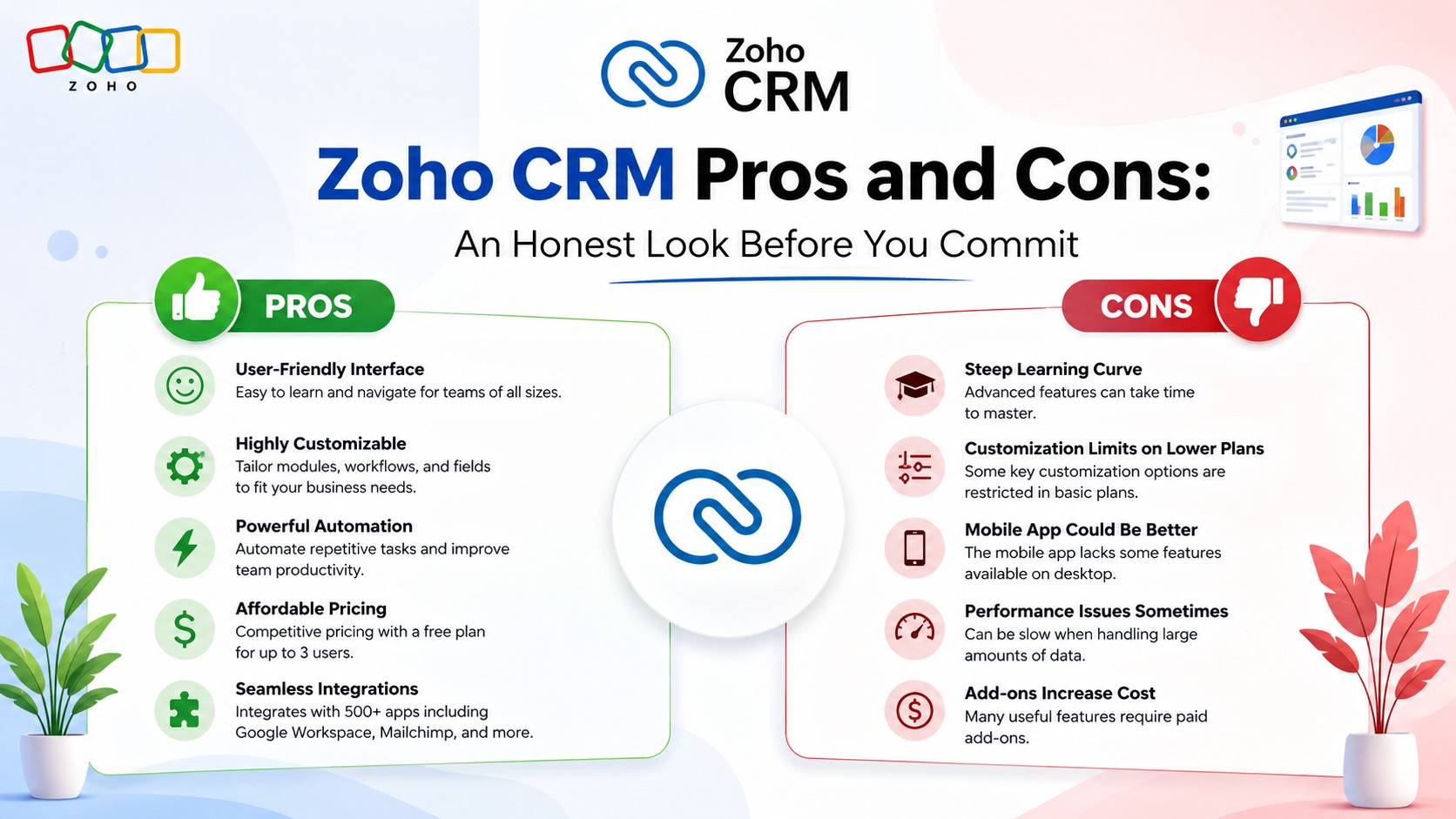
The main pros of Zoho CRM are strong value for money, deep no-code customisation, powerful workflow automation, and tight integration with 55+ other Zoho apps. The main cons are a steep configuration learning curve, support quality that varies by plan tier, native reporting limits on large datasets, and useful features locked behind higher editions.
| Zoho CRM Pros | Zoho CRM Cons |
| Excellent value against comparable platforms | Configuration takes real time and skill |
| Customise fields, modules, stages without code | Support response varies by plan tier |
| Strong automation — workflows, blueprints, assignment rules | Native reporting strains on very large datasets |
| Connects natively to Books, Desk, Projects, Inventory | Interface differs slightly across Zoho apps |
| Zia AI adds useful predictions and nudges | Key features gated behind higher editions |
| Scales from 5 users to a few hundred comfortably | Not ideal for very large multi-entity enterprises |
What Is Zoho CRM, and Who Is It Really Built For?
Zoho CRM is sales software that records every customer interaction from first enquiry to closed deal, then reports on it. It sits at the centre of the wider Zoho ecosystem — accounting, helpdesk, HR, marketing, projects — sharing one customer record across all of them.
Picture a fourteen-person industrial equipment supplier in Andheri. Enquiries arrive by phone, IndiaMART, WhatsApp and the website. The owner tracks them in a spreadsheet nobody updates after Tuesday. That is the business Zoho CRM was designed for — not a bank with three thousand reps.
And here is the thing most buyers get backwards. Zoho organises a sales process. It does not invent one. Companies that already know how they sell get value in weeks. Companies hoping the software will impose discipline usually get disappointed.
The Pros: Where Zoho CRM Genuinely Delivers
1. Value for money is not marketing spin
This is the reason most Indian businesses shortlist Zoho in the first place. A full twenty-person sales deployment costs a fraction of what comparable enterprise platforms charge for similar depth. There is also a free tier for very small teams, and it is usable rather than a crippled demo.
2. You can reshape almost everything without a developer
Custom fields, custom modules, renamed pipeline stages, conditional layouts, approval steps — most of it is drag and drop. A wedding photography studio can rename Deals to Bookings, add event date and venue fields, and delete the twenty irrelevant fields that ship by default. That flexibility usually costs extra elsewhere.
3. Automation that removes real hours from the week
Workflow rules assign leads by territory. Blueprints stop a rep from skipping a stage. Assignment rules route enquiries by product line. Scoring rules push the hot ones to the top. A capable operations person can build most of this in an afternoon — no Deluge scripting required.
4. The wider Zoho stack changes the maths
CRM alone is good. CRM connected to Zoho Books, Zoho Desk and Projects is a different product entirely. A won deal creates the invoice. A support ticket shows the deal history. For a company paying for four or five disconnected tools today, this is usually where the business case closes. Our guide to the top 10 Zoho products covers what else sits in the suite.
5. Zia adds practical intelligence, not gimmicks
Zia flags deals going cold, suggests the best time to call a contact, and spots unusual dips in activity. It is not magic. But it catches things a busy sales manager misses on a Thursday afternoon.
The Cons: Where Zoho CRM Frustrates People
Now the honest half — the parts that rarely survive a demo call.
1. The learning curve is in configuration, not usage
Adding a lead and moving a deal takes an afternoon to learn. Building blueprints, custom functions, multi-step approvals and Deluge scripts does not. Plenty of companies buy licences, poke around for a month, and drift back to spreadsheets. The software did not fail — the setup never happened.
2. Support quality depends on what you pay
Basic email support can be slow. Priority and enterprise tiers are noticeably better, and they cost more. If you are on a lower plan and something breaks during quarter-end closing, that wait feels long. This is the most common complaint in any honest Zoho CRM review.
3. Native reporting hits a ceiling
Standard reports and dashboards are well covered. Cross-module analysis, cohort views, or blending CRM data with Books and Desk data is where it runs out of road. You end up adding Zoho Analytics as a separate subscription. If leadership reporting matters to you, budget for it upfront rather than discovering it in month four.
4. Performance dips with very large data volumes
Under a hundred thousand records, it is fast. Push into millions of rows with heavy custom functions and mass updates, and list views start to lag. A distributor migrating eight years of order history in one go will feel it. Proper archiving during migration solves most of it — which is exactly why migration planning matters.
5. The interface is not perfectly consistent
Zoho has many apps, built by many teams, across many years. The design language shifts slightly between CRM, Books and Creator. It is an irritation rather than a blocker, but new users notice it in week one.
6. Edition gating catches people out
Blueprints, inventory modules, territory management, multi-user portals — several genuinely useful features sit only in higher editions. A plan that looked affordable turns into a different number once you add what you actually need. Map features to editions before you sign.
What Costs Are Easy to Miss?
The licence fee is the start, not the total. None of these are hidden exactly — they are just easy to overlook during evaluation.
| Cost Area | Why It Comes Up | When to Budget It |
| Zoho Analytics | Cross-app and leadership reporting | From day one if management needs dashboards |
| File storage & API limits | Document-heavy or integration-heavy use | Month 2–3, once volume builds |
| Telephony credits | Click-to-call and call recording | At go-live, if the team calls all day |
| Premium support | Faster response on critical issues | Before your first quarter-end on the system |
| Implementation & migration | Data cleanup, config, integrations | Upfront — this is the biggest single line |
| Training & adoption | Getting the team to actually use it | Go-live week and one refresher at 90 days |
Is Zoho CRM Worth It for Your Business?
For most growing businesses, yes — but the answer depends less on the software than on whether you commit to setting it up properly. Zoho CRM is worth it if you have a defined sales process, five or more people who need shared visibility, and someone internally willing to own the system. It is not worth it if you expect a perfect setup out of the box.
| Strong Fit | Think Twice |
| 5–200 users with a clear sales process | Thousands of users across multiple legal entities |
| Companies replacing spreadsheets and shared inboxes | Teams with nobody assigned to own the CRM |
| Businesses planning to use 3+ Zoho apps | Highly regulated niches needing specialist compliance tooling |
| Firms that want deep customisation without dev cost | Buyers wanting a packaged industry suite out of the box |
| Indian SMEs needing GST-linked sales-to-invoice flow | Organisations unwilling to invest in setup and training |
How Does Zoho CRM Compare to Salesforce and HubSpot?
A fair short version, without pretending any one platform wins everything.
| Factor | Zoho CRM | Salesforce | HubSpot |
| Total cost of ownership | Lowest | Highest | Middle, rises fast |
| Customisation depth | Very high | Highest | Moderate |
| Ease of first setup | Moderate | Complex | Easiest |
| Ecosystem breadth | 55+ own apps | Huge third-party marketplace | Strong marketing suite |
| Best fit | SMEs and mid-market | Large enterprise | Marketing-led teams |
How Do You Avoid the Most Common Zoho CRM Problems?
Most complaints trace back to setup, not software. A handful of habits prevent nearly all of them.
- Clean your data before migrating. Duplicates and half-filled records destroy user trust faster than any bug.
- Start with fewer fields. Twelve fields people fill in beat sixty that nobody touches.
- Name one internal owner. Even part-time. A CRM without an owner degrades within a quarter.
- Train on your process, not on the product. Show the team how to log their deals, not how Zoho works in general.
- Automate after go-live, not before. Watch how people actually work for a month, then build rules around reality.
- Review quarterly and retire what nobody uses. CRMs collect clutter the way garages do.
If your team does not have the bandwidth for this, structured Zoho consulting and proper Zoho training cost far less than a failed rollout you have to redo eight months later.
What Does a Realistic Rollout Look Like?
Take a mid-sized furniture manufacturer with three showrooms and an order book still living in Excel. A typical sequence runs like this.
| Stage | Timeline | What Happens |
| Discovery & data cleanup | Week 1–2 | Process mapping, duplicate removal, field decisions |
| Configuration | Week 3–4 | Pipelines, custom fields, roles, permissions, automation |
| Migration & testing | Week 5 | Import, validation, integration checks |
| Training & soft launch | Week 6–7 | Role-based training, one branch live first |
| Full rollout & hypercare | Week 8 | All users live, daily support window |
Nothing there is dramatic, and that is the point. The rollouts that fail are almost always the ones compressed into a weekend. Clean Zoho data migration and thought-through Zoho integration matter more than any feature on the pricing page.
Frequently Asked Questions
Is Zoho CRM good for small businesses?
Yes. Entry pricing is low, a free tier exists for very small teams, and a ten-person sales team can run pipelines, quotes and follow-ups affordably. The trade-off is that almost nothing is preconfigured for your industry. Very small teams sometimes do better starting on Zoho Bigin and upgrading later.
What are the main disadvantages of Zoho CRM?
A steep configuration learning curve, support quality that varies by plan tier, native reporting that strains on very large datasets, minor interface inconsistency across apps, and useful features locked behind higher editions. None are deal-breakers, but each needs budgeting for in time or money.
Is Zoho CRM difficult to learn?
Not difficult, but broad. Daily use — adding leads, moving deals, logging calls — takes an afternoon. Workflows, blueprints, custom functions and advanced reports are where teams get stuck without guidance. A short go-live training session plus a one-page internal guide resolves most everyday confusion.
Can Zoho CRM replace Salesforce?
For many mid-sized companies, yes. Zoho covers the core sales features most teams actually use — pipelines, forecasting, workflows, quotes, dashboards. Salesforce still leads on very large enterprise deployments and complex multi-entity structures. Under roughly two hundred users with reasonably standard processes, Zoho handles the job at a much lower total cost.
How long does a Zoho CRM implementation take?
A basic setup takes a few days. A proper rollout with custom fields, pipelines, automation, data migration and training usually runs four to eight weeks, depending on how messy your existing data is. Companies that rush this stage are almost always the ones who later say the CRM does not work.
Which Zoho CRM edition should I start with?
Professional suits most growing teams because it adds blueprints, inventory and stronger automation over Standard. Enterprise makes sense once you need advanced customisation, territory management or multi-user portals. Start one edition below what you think you need, run a full quarter, then upgrade when something specific actually blocks the team. Upgrading is simple; downgrading is a headache.
Do we need a Zoho partner, or can we configure it ourselves?
A basic pipeline can be self-configured. Once you need cross-app automation, Deluge functions, compliance-ready reporting or a clean migration from another CRM, a certified partner saves more time than it costs. The difference usually shows six months later — in whether people are still using the system. Ongoing Zoho support matters just as much as the initial build.
Get an Honest Read on Whether Zoho CRM Fits You
The Zoho CRM pros and cons balance out differently for every business. What tips it one way or the other is almost never the feature list — it is whether the system gets configured around how you actually sell, and whether your team is supported through the first ninety days.
Tech Magify LLP is a certified Zoho Advanced Partner with 24+ years in business technology, 1,100+ projects delivered and 50+ in-house experts. Our Mumbai office in Dadar East serves clients across South Mumbai, Bandra, Andheri, Powai, Thane and Navi Mumbai. Businesses looking for experienced zoho partners in mumbai work with us on the full chain — discovery, configuration, data migration, integration, training and post go-live support.
As a zoho authorized partner in mumbai, we will also tell you plainly if Zoho is the wrong fit for your business. A bad implementation helps nobody. Our consultants cover the full Zoho suite, with certified expertise across CRM, Books, Desk, People, Projects, Creator and Analytics.
Book a free 30-minute discovery call and we will map your sales process against what Zoho CRM can realistically do — before you commit to licences.