
It’s 11:40 on a Friday night and someone just bought the last blue hoodie on your website. Great news — except that same hoodie sold on your Amazon store six minutes ago, and nobody told your website. Monday morning you’re writing an apology email, refunding the order, and watching a one-star review land before the customer has even finished their coffee.
That, in one messy sentence, is overselling. And it happens to almost every growing store at some point.
The frustrating part? It’s almost entirely preventable. Not with more staff or more spreadsheets, but with one thing most sellers underestimate until it burns them — a properly synced link between every sales channel and the warehouse behind them. That’s exactly what a tool like Zoho Inventory is built to do, and by the end of this guide you’ll know how to sync your online store and warehouse so this never becomes your Monday morning again.
What is overselling, and why does it happen?
Overselling happens when you sell more units of a product than you actually have in stock, usually because your sales channels and warehouse inventory aren’t updating in real time. One channel sells an item, the stock count elsewhere stays unchanged, and a second customer buys something that no longer exists.
So it’s rarely carelessness. It’s a timing problem.
Picture your stock as a single number sitting in a warehouse. Now picture five different doors into that warehouse — your website, Amazon, Flipkart, a physical counter, a WhatsApp order. Every door can take stock out. But if the doors don’t talk to each other, each one thinks it has the full count. Two customers walk through two different doors and grab the same last item. Both get a confirmation. Only one gets a product.
The more channels you add, the faster this compounds. Which is exactly why fast-growing D2C brands feel it hardest — success itself creates the problem.
Why manual inventory tracking always breaks eventually
Most sellers start with a spreadsheet. Honestly, everyone does. It works fine at ten orders a day and quietly falls apart at a hundred.
The issue isn’t the spreadsheet. It’s the human updating it. Someone has to remember to log every sale, every return, every channel, every restock — and do it instantly, at 2 PM during a rush and at midnight during a sale. Miss one entry and the whole count drifts. Drift enough and you’re overselling without even knowing it yet.
There’s also the lag nobody accounts for. Even a diligent team updates stock in batches — end of shift, end of day. During those gaps, every channel is working off a stale number. And a sale during that gap is a coin flip on whether you can actually fulfil it.
The truth is simple. Manual tracking doesn’t scale because attention doesn’t scale. What scales is a system that does the counting for you — which is precisely the gap Zoho Inventory was designed to fill.
How does Zoho Inventory prevent overselling in real time?
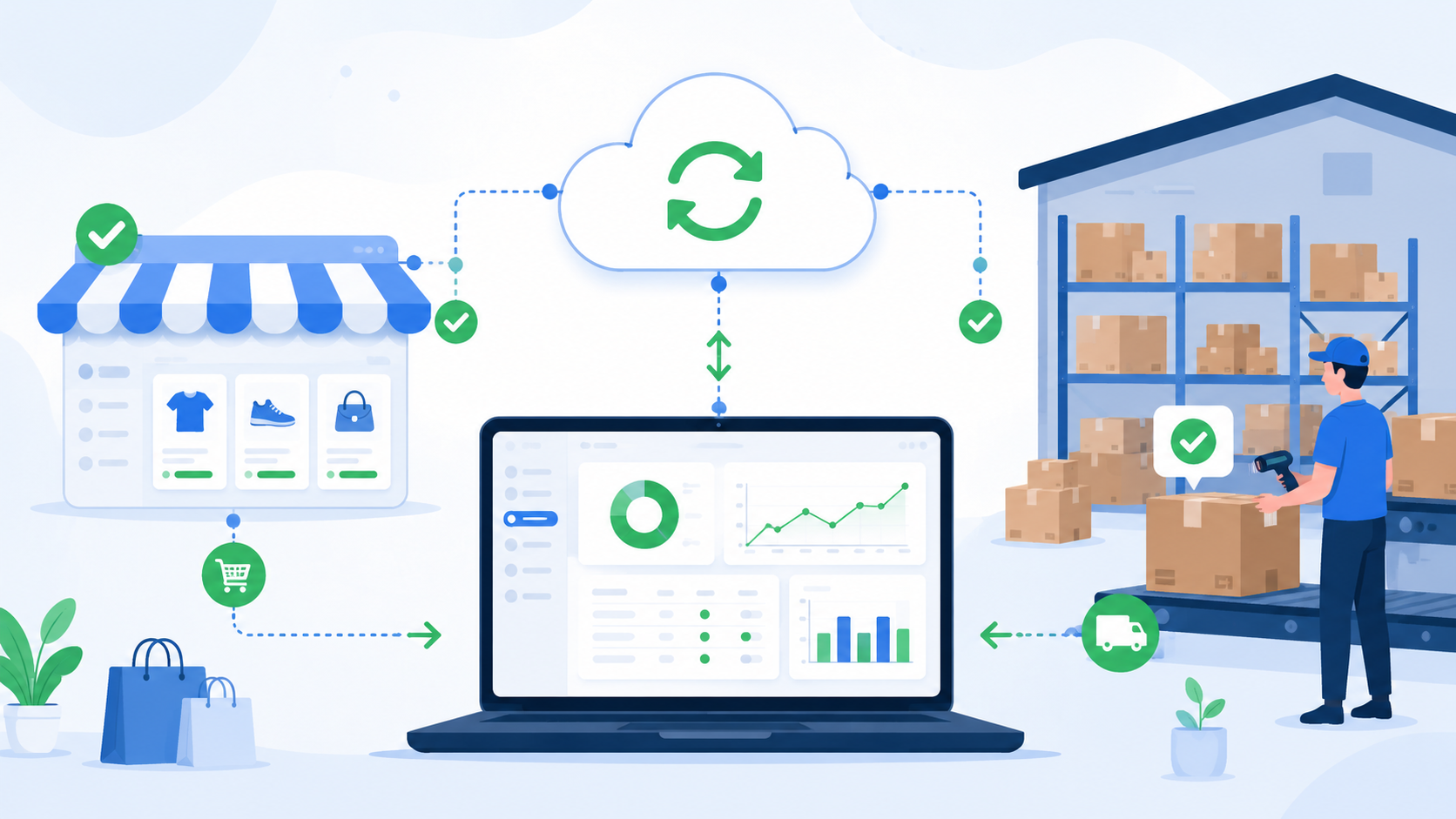
Zoho Inventory prevents overselling by connecting every sales channel to one central stock count, so the moment an item sells anywhere, the available quantity drops everywhere else within seconds. No channel can sell stock that another has already committed, because they all read from the same live number in Zoho Inventory.
Think of it as replacing five separate counts with one shared truth.
When a hoodie sells on your website, a synced system instantly deducts it from the master count and pushes that new number out to Amazon, Flipkart, your POS — all of it. By the time the next shopper loads the page, the item already shows as sold out. The race condition that caused overselling simply can’t happen, because there’s only one count to draw down from.
This is the shift from reactive to preventive. Instead of apologising after the fact, you close the door before the second customer ever reaches it.
What to look for when you sync your store and warehouse
Not every setup is equal. Some just move numbers around on a schedule and call it sync — which still leaves gaps. Here’s what actually matters when you connect your store to your warehouse, and where Zoho Inventory tends to stand out.
Real-time, not scheduled. A system that syncs “every hour” still leaves 59 minutes of exposure. You want updates that fire the instant a transaction happens, not on a timer.
True multichannel coverage. Your website, marketplaces, retail counter and manual orders all need to feed the same central count. A sync that covers your website but ignores Amazon has solved half a problem.
Warehouse-level accuracy. If you run more than one warehouse or storage location, the system should track stock per location and route orders to the right one — otherwise you promise stock from a warehouse that can’t actually ship it.
Automatic reservations. The moment an order is placed, that stock should be held — reserved — so it can’t be sold again even before it’s picked and packed.
Low-stock alerts and reorder points. Preventing overselling isn’t only about the last unit. Good software warns you before you run dry, so you can reorder in time and avoid the stockout altogether.
Where Zoho Inventory fits in
This is the part where the theory becomes a tool you can actually switch on. Zoho Inventory is built for exactly this problem — one central stock count feeding every channel, updating in real time as orders come in from any direction.
It connects your online store, marketplaces like Amazon and Flipkart, and your warehouses into a single system. Sell somewhere, and the available quantity drops everywhere. It handles multiple warehouses, reserves stock the moment an order lands, flags low-stock items before they run out, and gives you order and shipment tracking on top. For a growing store, that combination is the difference between chasing problems and preventing them. The way Zoho Inventory keeps stock synced across channels is genuinely one of the cleanest fixes for overselling available to Indian sellers right now.
But — and this matters — a tool is only as good as its setup. Connecting five channels, mapping SKUs correctly, configuring reorder points and warehouse rules, integrating it with your billing and CRM: that’s where most self-serve attempts stall. Get it wrong and you’ve built a faster way to be inaccurate.
A simple rollout that actually works
You don’t fix this overnight, and you shouldn’t try to. Start by auditing what you sell and where — every channel, every SKU, every warehouse. Messy, but necessary.
Then centralise. Pick one system as the single source of truth for stock and connect each channel into it one at a time, testing as you go. Reserve stock on order, set reorder points a little conservatively at first, and watch the numbers for a couple of weeks before you trust them completely.
And keep a human in the loop early on. Automation should be checked, not blindly believed, until you’ve seen it hold through a real sale spike. After that, it just runs.
Frequently asked questions
Can overselling really be fully prevented?
Yes, in practice. With real-time sync across every channel and automatic stock reservation on each order, the timing gap that causes overselling closes. The rare exceptions come from returns handling or damaged stock, which good inventory software also helps you manage.
Do I need separate software, or can my store platform handle it?
Most single-store platforms track their own stock but can’t see your other channels. Once you sell in more than one place, you need dedicated inventory software that sits above all channels and keeps one central count.
How quickly does synced stock update?
With a real-time system like Zoho Inventory, the available quantity typically updates within seconds of a sale on any connected channel, which is what makes overselling practically impossible.
Is this only for large businesses?
Not at all. Small and mid-sized sellers benefit the most, because they feel every lost sale and bad review sharply. The earlier you set up proper sync, the less painful your growth phase becomes.
Get your inventory synced right — the first time
Preventing overselling isn’t really an inventory problem. It’s a setup problem. And a clean, correctly configured system is what separates stores that scale smoothly from stores that firefight every festive sale. That’s where the right implementation partner earns their keep.
As a Zoho partner in India, Tech Magify LLP helps growing businesses set up Zoho Inventory the way it’s meant to work — every channel connected, warehouses mapped, stock reserved on order, reorder points tuned, and the whole thing integrated with your billing and CRM. A Zoho Advanced Partner with 24+ years of experience and 1100+ projects delivered across 15+ countries, the team has configured inventory and Zoho ONE systems for D2C brands, retailers and enterprises alike.
If overselling has cost you customers, reviews, or a few too many Monday-morning apologies, it’s worth fixing properly. Talk to the Tech Magify team about a Zoho Inventory setup built around how your business actually sells — so the last blue hoodie only ever sells once.