
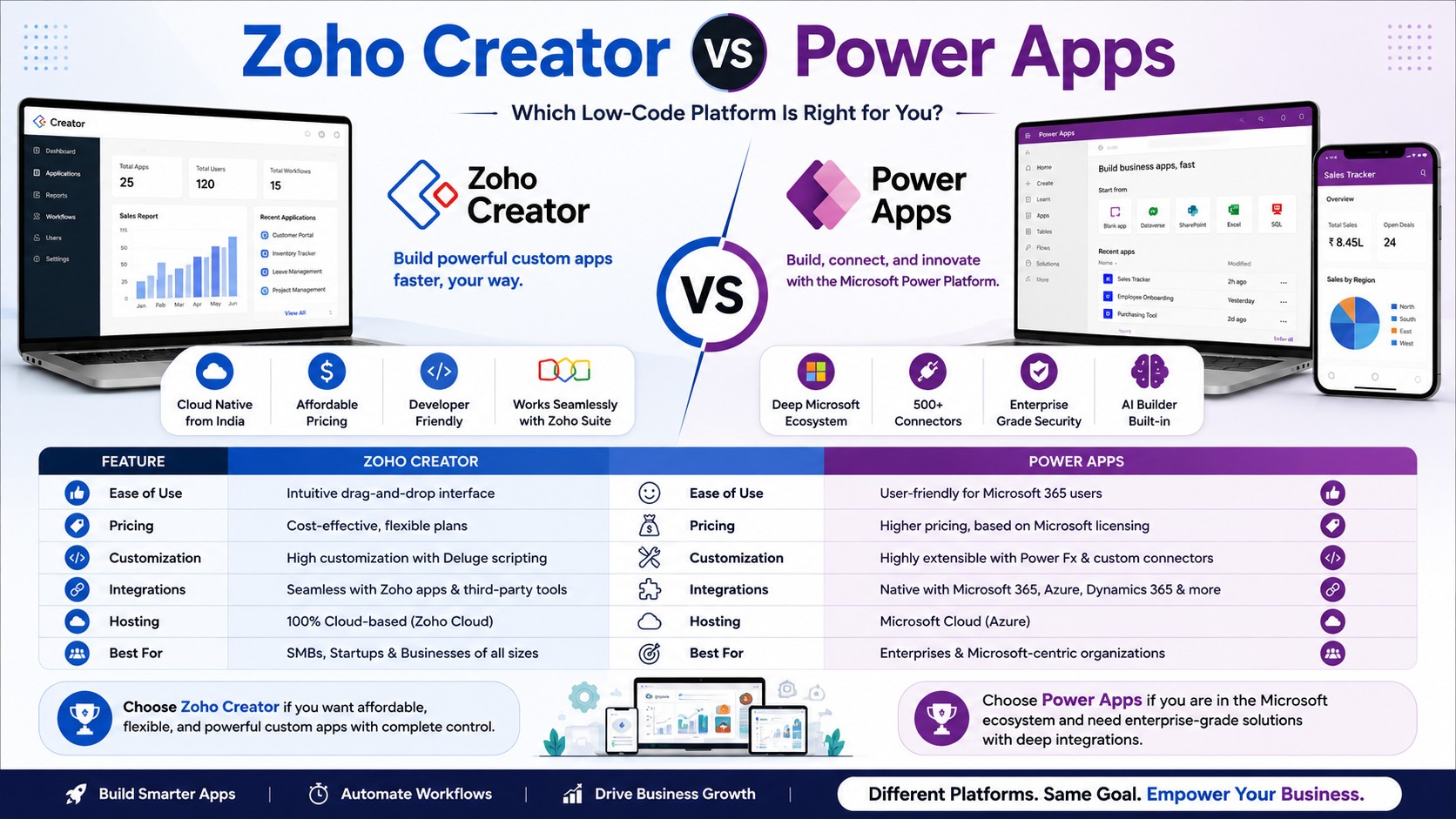
Quick Answer
Choose Microsoft Power Apps if your company already runs on Microsoft 365, SharePoint, Teams and Azure, and you have an IT team that can handle Dataverse, environments and licensing governance. Choose Zoho Creator if you want to build working apps faster, with predictable per-user pricing, automatic mobile apps, and without needing a licensing specialist to work out what you owe.
On price the headline rates are nearly identical — around 20 US dollars per user per month for the main plan on both. The difference shows up in the add-ons. Power Apps bills separately for advanced automation, BI, external portals and API capacity. Zoho Creator bundles Flow and Analytics into its Enterprise tier.
Both platforms let people build business apps without writing much code. Both are backed by companies that are not going anywhere. And both are chosen for reasons that often have nothing to do with the product itself — usually, whichever ecosystem the business already lives in.
That said, the two are genuinely different in build speed, cost predictability and who can actually use them. Here is the comparison as it stands in 2026.
What Are You Actually Comparing?
Zoho Creator
A low-code platform from Zoho Corporation, the Chennai-headquartered company behind Zoho CRM and Zoho Books. You build apps using drag-and-drop forms, reports, pages and workflows, with a scripting language called Deluge when you need logic. Every app you build automatically works on web, iOS and Android without a separate mobile build.
Microsoft Power Apps
Part of the Microsoft Power Platform, alongside Power Automate, Power BI, Power Pages and Copilot Studio. You build canvas apps or model-driven apps, usually on top of Microsoft Dataverse, and connect them to SharePoint, Teams, Dynamics 365, SQL Server or hundreds of other data sources. Formula logic is written in Power Fx, which feels similar to Excel formulas.
Both are mature. Neither is a toy. The choice comes down to fit.
The Power Apps Licensing Change Most People Missed
This matters if you were planning to budget Power Apps at the cheap entry price.
In January 2026, Microsoft removed the Power Apps Per App plan — the 5 dollars per user per app per month option — from its licensing guide for most new non-CSP customers. CSP channel availability was restored in April 2026, and existing Enterprise Agreement customers can still renew, but new buyers outside CSP now have two production paths:
- Power Apps Premium at 20 US dollars per user per month, dropping to 12 dollars at 2,000-plus licences.
- Pay-as-you-go at roughly 10 US dollars per active user per app per month, billed through Azure.
For organisations that had built their business case on the 5 dollar per-app plan, that is a jump. Industry commentary at the time put the cost increase for affected customers somewhere between double and quadruple, depending on how many apps each user touched.
Why this matters for your decision
It is not that Power Apps became expensive. It is that Power Apps licensing changes, and it changes in ways that are hard to predict when you are three years into a rollout. If cost certainty over a five-year horizon matters to your board, that is a real risk factor to weigh — not a marketing point.
Where Power Apps Genuinely Wins
We are a Zoho partner. That does not make Power Apps a weak product — for the right company it is clearly the better choice.
1. You already live in Microsoft
If your data sits in SharePoint, your team works in Teams, your identity runs on Entra ID and your warehouse is in Azure, Power Apps is the path of least resistance. Apps embed directly inside Teams. Single sign-on is already solved. There is no integration project because there is nothing to integrate.
2. Dataverse and enterprise data modelling
Dataverse gives you a proper relational data platform with role-based security at the row and field level, business rules, and a common schema shared with Dynamics 365. For large organisations with complex data governance requirements, this is a serious advantage that Zoho Creator does not match at the same depth.
3. Application lifecycle management
Separate development, test and production environments. Solution packaging. Azure DevOps or GitHub pipelines. Data loss prevention policies applied across the whole tenant. If you have a formal IT governance process and auditors who ask about change control, Power Apps has the tooling.
4. Connector breadth
Over a thousand connectors, including deep ones into the Microsoft stack and most enterprise systems. If you need to talk to an obscure enterprise product, the odds are better here.
5. Talent pool in large enterprises
In big Indian IT services companies and MNC captives, Power Platform skills are widely available. Hiring or contracting a Power Apps developer in Bengaluru, Hyderabad or Pune is straightforward.
Where Zoho Creator Genuinely Wins
1. Speed from idea to working app
This is Creator’s strongest claim. You define a form, Creator generates the database table, the report views, the permissions structure and the mobile app. In Power Apps, a canvas app that looks good on a phone usually needs deliberate design work for each screen size. Creator handles it by default.
For a straightforward internal tool — field service log, dealer order form, site inspection checklist, asset register — a competent builder gets to a usable version in Creator noticeably faster.
2. Pricing you can explain to your finance team
Creator is per user, per month, across three plans. There is no separate licence for automation, no capacity add-on for API requests, no per-100-users charge for external portals in the base model. Enterprise bundles Zoho Flow for integrations and Zoho Analytics for BI into the same subscription.
Power Apps quotes look simple until you add Power Automate premium for real automation, Power BI for reporting, Power Pages for external users, and a requests add-on when you exceed API limits.
3. Native mobile apps without extra work
Every Creator app runs on iOS and Android automatically, with offline data capture. For Indian businesses with field teams — sales officers, service engineers, site supervisors, distributors — this is often the whole reason the project exists.
4. It plugs into the Zoho ecosystem
If you already run Zoho CRM, Books, People or Desk, Creator sits alongside them with no middleware. A custom warranty registration app can read CRM contacts and write invoices to Books directly. Our guide to Zoho CRM integrations for Indian businesses covers what that connected setup looks like in practice.
5. Lower barrier for non-IT teams
Operations managers and process owners can build useful things in Creator with light training. Power Apps genuinely needs someone who understands Dataverse relationships, environment strategy and Power Fx before you get past a simple form.
Feature-by-Feature Comparison
| Area | Zoho Creator | Microsoft Power Apps |
| Vendor | Zoho Corporation (India) | Microsoft (USA) |
| App types | Web, mobile, tablet from one build | Canvas apps, model-driven apps, Power Pages |
| Mobile apps | Auto-generated for iOS and Android, offline capable | Needs deliberate responsive design; mobile player app |
| Data layer | Built-in database, plus external data sources | Dataverse (premium), SharePoint, SQL, and more |
| Scripting | Deluge (proprietary, simple to learn) | Power Fx (Excel-like formulas) |
| Connectors | Data sources 5 to 30 by plan, plus custom connectors | 1,000+ standard and premium connectors |
| Automation | Workflows, blueprints, schedules; Zoho Flow at Enterprise | Power Automate, often licensed separately |
| BI and reporting | Built-in reports; Zoho Analytics at Enterprise | Power BI, licensed separately |
| External users | Customer portal add-on, priced by portal user count | Power Pages, capacity-based pricing |
| AI | 20 to 100 custom AI models, 50 to 250 ready models by plan | AI Builder, credit-based |
| Governance | Roles, permissions, audit trail, SSO add-on | Environments, DLP policies, solutions, ALM pipelines |
| Free tier | 1 user, 1 app, 250MB, 1,000 records | Developer Plan for non-production use only |
| Learning curve | Low to moderate | Moderate to steep |
| Best team profile | Ops teams with light IT support | IT-led teams with Power Platform skills |
Pricing: The Part That Decides Most Projects
Published list prices, annual billing, in US dollars. Zoho bills Indian accounts in rupees at locally set rates, and Microsoft prices vary by agreement type — check both vendors’ pricing pages for your exact figures before budgeting.
| Plan | Price (annual billing) | What You Get |
| Zoho Creator Standard | About $12 / user / month | 1 application, 20 custom AI models, 5 data sources |
| Zoho Creator Professional | About $20 / user / month | Unlimited apps, 15 data sources, 100 AI models |
| Zoho Creator Enterprise | About $25 / user / month | 30 data sources, plus Zoho Flow and Zoho Analytics bundled |
| Zoho Creator Flex | Custom | Pick features and limits a la carte |
| Power Apps Premium | $20 / user / month | Unlimited apps and Power Pages sites, Dataverse, premium connectors |
| Power Apps Premium (2,000+ seats) | $12 / user / month | Same features, volume rate |
| Power Apps pay-as-you-go | About $10 / active user / app / month | Billed via Azure, pay only for users who open the app |
A worked example: 25 users, three years
Assume a mid-sized Indian company building three internal apps for 25 staff — a field service tracker, a dealer order portal and an asset register — with integration to accounting and some reporting.
| Cost Line | Zoho Creator | Power Apps |
| Core platform, 25 users, 3 years | Professional: about $18,000 | Premium: about $18,000 |
| Automation engine | Included (Flow bundled at Enterprise) | Power Automate premium often added separately |
| Business intelligence | Zoho Analytics bundled at Enterprise | Power BI licensed separately, from about $14/user/month |
| External portal for dealers | Customer portal add-on by user count | Power Pages, capacity-based, commonly quoted around $200 per 100 authenticated users per month |
| API capacity overage | Cloud function limits by plan | Power Platform Requests add-on, $50/month per 10,000 daily requests |
| Mobile apps | Included | Included, but more build effort |
| Implementation | Project cost | Project cost, usually higher due to Dataverse and ALM setup |
The honest pricing verdict
At the licence line, these platforms cost about the same. The difference is what sits underneath. Power Apps is a platform of separately licensed components — which gives large enterprises flexibility and gives small ones a budgeting headache. Zoho Creator bundles more into fewer SKUs, which is simpler but gives you less room to buy exactly what you need at enterprise scale.
If you are under 100 users, Creator is usually the cheaper and more predictable total. Above a few hundred users inside a Microsoft-standardised enterprise, Power Apps volume pricing and existing agreements often win.
For a broader view of what a full project costs beyond licences, see our breakdown of Zoho implementation cost in India.
Which One Is Faster to Build In?
Speed depends on what you are building. Rough guidance from projects we have delivered and seen:
| App Type | Faster In | Why |
| Simple data-capture app with mobile access | Zoho Creator | Form to working mobile app in hours, not days |
| Field service or inspection app with offline mode | Zoho Creator | Offline capture is built in |
| App embedded inside Microsoft Teams | Power Apps | Native Teams integration |
| App reading heavily from SharePoint or Dynamics | Power Apps | Direct connectors, no data duplication |
| Multi-entity app with complex row-level security | Power Apps | Dataverse security model is deeper |
| App that must write into Zoho CRM or Books | Zoho Creator | Native, no middleware |
| Customer or dealer-facing portal | Depends | Creator portal add-on vs Power Pages — price it both ways |
| Quick internal tool built by an ops manager | Zoho Creator | Lower skill barrier |
India-Specific Considerations
Billing and currency
Zoho publishes rupee pricing for Indian accounts and issues GST invoices locally, which most finance teams find simpler. Microsoft pricing in India depends on your agreement type and reseller, and pay-as-you-go runs through an Azure subscription.
Support hours
Zoho’s India support runs in Indian business hours with local numbers and demos available in Hindi and several regional languages. Microsoft support quality in India depends heavily on your partner and agreement tier.
Talent
Power Platform developers are easier to find in large metros and IT services companies. Zoho Creator developers are fewer but the platform needs less specialist skill, so internal staff can often be trained up. Both routes work — the question is whether you want to hire for it or build it into your existing team.
What Indian businesses actually build
From what we see across manufacturing, distribution, healthcare and financial services clients, the most common low-code projects in India are:
- Field sales and merchandising apps for distributor and retailer visits
- Service engineer job cards with photo capture and customer signature
- Dealer and channel partner portals for order placement
- Site inspection, safety audit and quality checklist apps
- Asset and equipment registers with maintenance schedules
- Internal approval workflows for purchase, travel and expense
- Compliance and document tracking for regulated sectors
Most of these are mobile-first and offline-tolerant, which is the category where Creator has a structural head start.
Which Should You Choose? Decision Table
| Your Situation | Better Fit | Why |
| Already standardised on Microsoft 365 and Azure | Power Apps | No integration work, single identity, Teams embedding |
| Already running Zoho CRM, Books or People | Zoho Creator | Native connection to your existing data |
| Field teams needing offline mobile apps | Zoho Creator | Auto-generated mobile apps with offline capture |
| Enterprise with formal ALM and audit requirements | Power Apps | Environments, solutions, DLP policies, pipelines |
| Under 50 users, want predictable cost | Zoho Creator | Fewer SKUs, less licensing risk |
| 2,000+ users inside a Microsoft enterprise agreement | Power Apps | Volume pricing at $12 per user |
| Ops team wants to build without heavy IT support | Zoho Creator | Lower learning curve |
| Need complex row-level and field-level security | Power Apps | Dataverse security model |
| Manufacturing or distribution with dealer network | Zoho Creator | Faster portal and mobile delivery |
| No existing ecosystem, starting fresh | Zoho Creator | Lower total cost and faster time to first working app |
Honest Limitations of Each
Where Zoho Creator falls short
- Pixel-level UI control is limited. If you need a precisely designed customer-facing interface, you will hit friction or need widgets.
- Deluge is proprietary. Skills do not transfer outside the Zoho ecosystem the way SQL or JavaScript do.
- Enterprise governance tooling is lighter than Power Platform’s environment and DLP model.
- You are committing to the Zoho ecosystem. That is fine if you are already there, and a consideration if you are not.
Where Power Apps falls short
- Licensing complexity is genuine, not exaggerated, and it changed materially in January 2026.
- Real cost is hard to forecast because automation, BI, portals and API capacity are priced separately.
- Mobile apps take more deliberate effort than the marketing suggests.
- You usually need IT involvement. The citizen-developer promise works better in theory than in most mid-sized Indian companies.
The Verdict
If your company runs on Microsoft, use Power Apps. Fighting your own ecosystem to save a few dollars per user is a bad trade, and Dataverse plus Power Platform governance is genuinely strong at enterprise scale.
For most Indian small and mid-sized businesses — the ones with field teams, dealer networks, paper-based processes and no dedicated Power Platform developer — Zoho Creator gets you a working, mobile-ready application faster and at a cost you can predict three years out. That combination is why it wins more of these projects in the SME segment than its market share would suggest.
The wrong way to decide is by feature checklist. The right way is to pick one real process, scope it properly, and estimate the total three-year cost including automation, reporting and portals. The answer usually becomes obvious at that point.
Frequently Asked Questions
Is Zoho Creator better than Power Apps?
Neither is universally better. Zoho Creator is stronger for fast delivery, automatic mobile apps and predictable pricing, which suits small and mid-sized businesses. Power Apps is stronger for organisations already standardised on Microsoft 365 and Azure, and for enterprises needing Dataverse security and formal application lifecycle management.
Which is cheaper, Zoho Creator or Power Apps?
The headline prices are close — around 20 US dollars per user per month for the main plan on both. Zoho Creator usually works out cheaper in total because its Enterprise tier bundles integration and BI, while Power Apps licenses Power Automate premium, Power BI, Power Pages and API capacity separately. Above 2,000 users, Power Apps volume pricing of 12 dollars per user narrows the gap.
Did Microsoft remove the Power Apps per-app plan?
In January 2026 Microsoft removed the Per App plan from its licensing guide for most new non-CSP customers. CSP availability was restored in April 2026 and existing Enterprise Agreement customers can renew, but new buyers outside CSP are directed to Power Apps Premium at 20 dollars per user per month or pay-as-you-go at about 10 dollars per active user per app per month.
Can Zoho Creator build mobile apps?
Yes. Every application built in Zoho Creator runs natively on iOS and Android without a separate build, and supports offline data capture. This is one of the clearest practical advantages over Power Apps for field-team applications.
Does Zoho Creator have a free plan?
Yes. The free edition covers 1 user, 1 application, 250MB of storage and 1,000 records. It is suitable for evaluating the platform, not for running a business process at scale.
Do I need a developer to use Zoho Creator?
For a simple form-and-report application, no — an operations person with light training can build it. For anything involving integrations, complex workflow logic, custom APIs or portals, you will want a developer or a certified partner. Deluge scripting is simple compared to conventional coding, but it is still code.
Can Zoho Creator integrate with Microsoft 365 or SharePoint?
Yes, through connectors and REST APIs, though it is not as native as Power Apps talking to SharePoint. If the majority of your data lives in the Microsoft stack, that alone is a strong argument for Power Apps.
Which platform is faster to build in?
For simple internal tools and mobile-first apps, Zoho Creator is typically faster because the database, permissions and mobile app are generated for you. For apps sitting on top of Dataverse, SharePoint or Dynamics 365, Power Apps is faster because there is no integration layer to build.
Is Zoho Creator suitable for enterprises?
Yes, and Zoho publishes enterprise customers using it. That said, if your organisation has formal change control, tiered environments and auditors asking about deployment pipelines, Power Platform’s governance tooling is more mature. Assess against your actual compliance requirements rather than the marketing on either side.
Can I migrate from Power Apps to Zoho Creator or the other way round?
There is no automated migration path. Data can be exported and imported, but the application logic, forms and workflows have to be rebuilt. Treat a platform switch as a rebuild project, which is exactly why the initial choice deserves proper analysis.
Need Help Deciding — or Building?
Tech Magify LLP brings 24+ years of enterprise software experience and works with 500+ clients globally as a certified Zoho Advanced Partner. Our 50+ consultants across Mumbai, Ahmedabad, Pune and Perth build custom applications on Zoho Creator, develop Deluge functions, widgets and extensions, and connect them to your existing systems through custom APIs.
If Power Apps is the better answer for your situation, we will say so. We would rather turn down a project than build the wrong thing on the wrong platform.
Where to go next:
- See our Zoho development services — Creator apps, custom widgets, extensions and API integration.
- Browse the full Zoho Suite implementation services across 55+ applications.
- Still scoping? Start with a Zoho consulting engagement and a process review.
- Adding AI to your apps? See Zoho Zia implementation.
- Managing the build itself? Look at Zoho Projects implementation.
- Comparing vendors? Read our guide to Zoho partners in India and what a Zoho Authorized Partner is.
- Learn more about Tech Magify and the team behind the work.
Talk to a Zoho Advanced Partner in Mumbai
If your business is in Mumbai, Thane or Navi Mumbai, sit down with a Zoho Advanced Partner in Mumbai who will scope one real process with you, estimate the three-year total cost on both platforms, and tell you honestly which one fits.
Book a free discovery call with a certified Zoho partner in Mumbai and get a clear scope, timeline and fixed cost before you commit to anything.