The software development industry never stands still. Every year brings new tools, frameworks, architectures, and approaches that reshape how developers build products and how businesses deliver value through technology. In 2026, that pace of change has accelerated further, driven primarily by the rapid maturation of artificial intelligence and its deep integration into every layer of the development process.
For developers, CTOs, startup founders, and technology decision-makers, staying ahead of these trends is not optional. The companies that adopt the right technologies at the right time build faster, deploy more reliably, and deliver better experiences for their users. Those that fall behind end up spending their resources maintaining outdated systems while competitors race ahead.
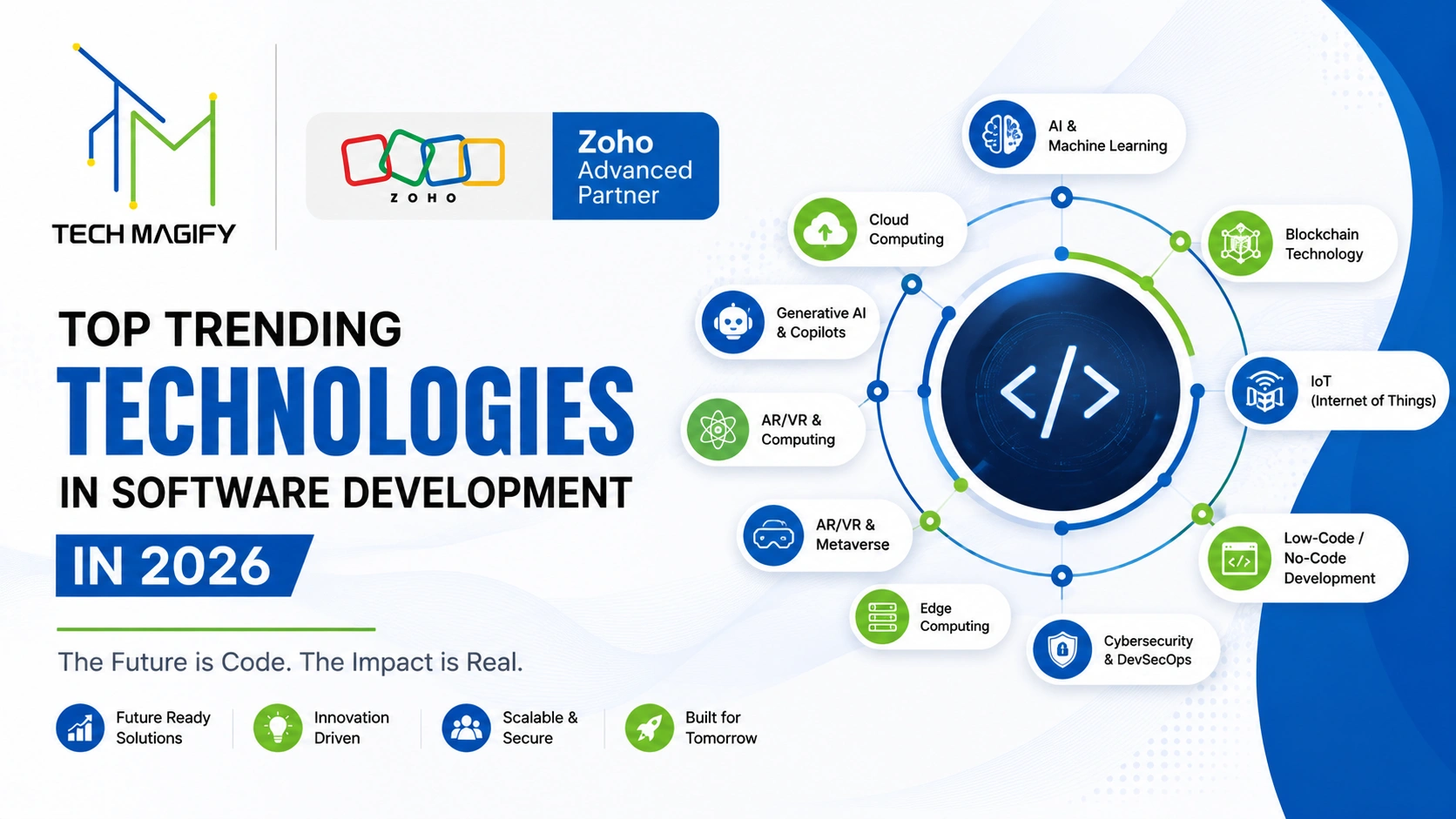
In this article, we explore the Top Trending Technologies in Software Development in 2026 — the technologies that are actively reshaping how software is designed, built, deployed, and maintained across industries.
Why Keeping Up with Technology Trends Matters in 2026
The global software market is projected to reach $2.2 trillion by 2034, with artificial intelligence, cloud computing, and automation driving the bulk of that growth. The number of software developers worldwide exceeded 36 million in 2025, and the competition for building faster, smarter, and more reliable products has never been greater.
Businesses that leverage the latest software development technologies gain clear advantages:
- Faster product development cycles and time-to-market
- Reduced infrastructure and operational costs through automation
- Improved application security and compliance
- Better user experiences that drive higher retention and conversion
- Greater ability to scale without proportional increases in team size
- Stronger competitive positioning in rapidly evolving markets
Top Trending Technologies in Software Development 2026 — Quick Overview
| Rank | Technology | Primary Use Case | Adoption Level |
| 1 | Artificial Intelligence & Machine Learning | Automation, Predictions, Intelligent Apps | Very High |
| 2 | Generative AI & AI Coding Assistants | Code Generation, Content, Productivity | Very High |
| 3 | Cloud-Native Development | Scalable, Resilient App Architecture | High |
| 4 | DevSecOps | Secure, Continuous Software Delivery | High |
| 5 | Low-Code / No-Code Platforms | Rapid App Development, Citizen Dev | High |
| 6 | Edge Computing & IoT | Real-Time Processing, Smart Devices | Growing |
| 7 | Blockchain Technology | Secure Transactions, Smart Contracts | Growing |
| 8 | Quantum Computing | Complex Problem Solving, Cryptography | Emerging |
| 9 | Augmented Reality & Virtual Reality | Immersive Experiences, Training, Retail | Growing |
| 10 | WebAssembly (Wasm) | High-Performance Web Apps, Cross-Platform | Growing |
1. Artificial Intelligence and Machine Learning
Artificial Intelligence and Machine Learning have moved from being futuristic concepts to foundational components of modern software development. In 2026, AI is no longer a feature you add to a product — it is a core part of how software thinks, learns, and responds to user behavior.
Over 90% of software development teams were already using AI tools in their workflows by 2025, and that figure has continued to climb. From intelligent recommendation engines and predictive analytics to natural language processing and computer vision, AI and ML are enabling developers to build products that were simply not possible five years ago.
The most significant shift in 2026 is the rise of agentic AI — AI systems that do not just respond to inputs but autonomously plan, execute, and optimize tasks. By 2028, a third of all enterprise software is expected to include agentic AI capabilities, making it one of the most important trends for development teams to understand and adopt.
Key Applications
- Intelligent automation of business workflows
- Predictive analytics and data-driven decision making
- Natural language processing for chatbots and voice interfaces
- Computer vision for image recognition and quality control
- Personalization engines for eCommerce and SaaS platforms
- Anomaly detection and fraud prevention in fintech applications
2. Generative AI and AI Coding Assistants
Generative AI has fundamentally changed the productivity equation for software development teams. Tools like GitHub Copilot, Cursor, Windsurf, and other AI-powered coding assistants are now standard in the toolkit of modern developers, automating routine coding tasks, generating test cases, writing documentation, and even refactoring legacy code.
What makes 2026 different from previous years is the emergence of agentic IDEs — development environments that go beyond autocomplete to actively manage project context, make changes across repositories, infer developer intent, and handle multi-step development tasks autonomously. These tools are reducing the time developers spend on boilerplate work and freeing them to focus on architecture, design, and problem-solving.
Beyond code generation, generative AI is also accelerating content production, API documentation, test automation, and even product requirement generation — making it one of the highest-impact technologies in the software development landscape today.
Key Applications
- AI-assisted code generation and autocompletion
- Automated test case generation and QA
- Technical documentation and API documentation
- Legacy code refactoring and modernization
- Natural language to code conversion
- Intelligent project management and sprint planning
3. Cloud-Native Development
Cloud-native development has crossed the threshold from a modern approach to the baseline expectation in 2026. Technologies like Kubernetes, microservices, containerization, and service meshes are no longer considered advanced practices — they are simply how modern applications are built.
Businesses across every industry are migrating legacy monolithic applications to cloud-native architectures to gain the scalability, resilience, and deployment flexibility that modern digital products demand. The shift to cloud-native is also accelerating the adoption of DevOps practices, as containerized, microservice-based architectures naturally support continuous integration and continuous delivery pipelines.
A key development in 2026 is the rise of platform engineering — dedicated internal teams that build and maintain reusable development platforms, tooling, and infrastructure components that other development teams consume. Gartner predicts that up to 80% of software engineering organizations will form dedicated platform teams by 2026 to accelerate delivery and reduce operational complexity.
Key Applications
- Microservices architecture design and implementation
- Kubernetes orchestration and container management
- Serverless computing and Function-as-a-Service (FaaS)
- Multi-cloud and hybrid cloud deployments
- Internal developer platforms and golden paths
- Cloud cost optimization with FinOps practices
4. DevSecOps
Security can no longer be an afterthought in software development. DevSecOps — the integration of security practices directly into the development and operations pipeline — has become one of the most critical disciplines in the software industry in 2026. With cyberattacks growing in frequency and sophistication, organizations that bolt on security after development is complete are exposing themselves to serious risk.
DevSecOps shifts security left — bringing it into the earliest stages of development, from code writing and dependency management to testing and deployment. Automated security scanning, vulnerability detection, Software Bill of Materials (SBOMs), and digital provenance tracking are now standard components of modern CI/CD pipelines.
Regulatory frameworks like the EU AI Act are also driving adoption, requiring organizations to track the origin and integrity of AI-generated content, code, and software components — a practice known as digital provenance that is becoming a compliance requirement rather than just a best practice.
Key Applications
- Automated security scanning in CI/CD pipelines
- Software composition analysis and dependency management
- Infrastructure-as-code security and compliance
- Software Bill of Materials (SBOM) generation
- Zero-trust architecture implementation
- AI-assisted threat detection and vulnerability management
5. Low-Code and No-Code Platforms
The low-code and no-code market reached approximately $45 billion in 2025 and is growing at a nearly 28% CAGR — making it one of the fastest-growing segments in the entire technology industry. In 2026, these platforms are enabling businesses to build internal tools, automate workflows, and launch customer-facing applications in a fraction of the time it would take with traditional development.
What has changed in 2026 is the sophistication of what low-code and no-code platforms can deliver. Finance teams are building budgeting tools. HR departments are designing onboarding workflows. Marketing teams are launching campaign microsites. All without writing a single line of code, and all within days rather than weeks.
For professional development teams, low-code platforms are also accelerating the creation of routine CRUD applications, admin dashboards, and internal portals — freeing senior developers to focus on complex, high-value product features. Gartner projects the low-code technology market will reach $44.5 billion by 2026, underscoring its mainstream adoption.
Key Applications
- Internal business tool development
- Workflow automation and process digitization
- Customer portal and dashboard creation
- Mobile app development for non-technical teams
- Rapid MVP development for startups
- Enterprise application integration and automation
6. Edge Computing and IoT
Edge computing and the Internet of Things are transforming how software interacts with the physical world. Rather than sending all data to centralized cloud servers for processing, edge computing brings computation closer to where data is generated — on devices, sensors, and local servers — dramatically reducing latency and bandwidth consumption.
In 2026, edge computing is becoming critical for applications that require real-time responsiveness: autonomous vehicles, smart manufacturing, remote healthcare monitoring, industrial IoT, and augmented reality experiences all depend on the ability to process data at the edge without round-trips to the cloud.
The IoB (Internet of Behavior) market, which applies behavioral data collected from IoT devices to improve user experiences and business decisions, reached $432.2 billion in 2023 and is growing at over 23% annually through 2032 — driven by advances in AI, data analytics, and behavioral science.
Key Applications
- Real-time data processing for industrial IoT systems
- Smart city infrastructure and traffic management
- Remote health monitoring and medical devices
- Autonomous vehicle software and sensor fusion
- Retail analytics and in-store customer experience
- Edge AI for on-device inference without cloud dependency
7. Blockchain Technology
Blockchain technology has matured significantly from its early association with cryptocurrency speculation. In 2026, blockchain is being applied across industries as a foundational layer for building secure, transparent, and tamper-proof systems — from supply chain management and digital identity verification to healthcare records and financial services.
Smart contracts — self-executing agreements written in code and deployed on blockchain networks — are enabling businesses to automate complex multi-party transactions without the need for intermediaries, reducing both cost and processing time. The adoption of blockchain in enterprise software development is accelerating as more organizations recognize its value for compliance, audit trails, and data integrity.
Key Applications
- Smart contract development for finance and legal
- Supply chain transparency and provenance tracking
- Digital identity and decentralized authentication
- NFT and tokenization platforms
- Healthcare data security and patient record management
- Cross-border payment systems and DeFi applications
8. Quantum Computing
Quantum computing has long occupied the space between research breakthrough and practical application, but in 2026 that gap is narrowing. While fully fault-tolerant quantum computers remain a few years away for most commercial applications, quantum computing is already delivering value in specific high-complexity domains where classical computers struggle — drug discovery, materials science, financial modeling, and cryptography.
For software developers, the most immediate relevance of quantum computing in 2026 is post-quantum cryptography — the development of encryption algorithms that are resistant to future quantum attacks. Organizations that handle sensitive data, financial transactions, or government information are already beginning to transition their security infrastructure to quantum-resistant standards.
Key Applications
- Post-quantum cryptography and security infrastructure
- Optimization problems in logistics and supply chain
- Drug discovery and molecular simulation
- Financial risk modeling and portfolio optimization
- Machine learning acceleration with quantum algorithms
- Climate modeling and scientific computing
9. Augmented Reality and Virtual Reality
Augmented Reality and Virtual Reality have expanded far beyond gaming and entertainment in 2026. WebAR — augmented reality that runs directly in a browser without requiring a dedicated app download — is emerging as one of the most significant software development trends of the year, lowering the adoption barrier for immersive experiences dramatically.
With 5G rollouts accelerating and browser-based rendering improving, businesses across retail, real estate, education, healthcare, and manufacturing are deploying AR and VR applications to improve customer engagement, training effectiveness, and remote collaboration. When AR experiences happen instantly in a browser — with no downloads or onboarding barriers — the technology stops being a novelty and starts delivering real business value.
Key Applications
- WebAR for e-commerce product visualization
- Virtual training and simulation for enterprise teams
- Augmented reality for field service and remote support
- Immersive real estate and architecture visualization
- Healthcare surgical planning and medical education
- Virtual showrooms and interactive retail experiences
10. WebAssembly (Wasm)
WebAssembly is a binary instruction format that enables high-performance code written in languages like C, C++, Rust, and Go to run in web browsers at near-native speed. In 2026, WebAssembly is gaining significant momentum as developers look for ways to build more powerful, performance-intensive web applications without sacrificing cross-platform compatibility.
Beyond the browser, WebAssembly is also being adopted in server-side environments and edge computing platforms — enabling developers to run lightweight, sandboxed application components at the network edge with minimal overhead. As more frameworks and runtimes adopt Wasm support, it is positioning itself as an important cross-platform execution standard for the next generation of software applications.
Key Applications
- High-performance web application development
- Browser-based video editing, gaming, and CAD tools
- Edge computing and serverless function execution
- Cross-platform plugin systems and extension architectures
- Running existing C/C++ codebases in web environments
- Portable application distribution across platforms
How Businesses Can Adopt These Technologies Effectively
Understanding technology trends is one thing. Successfully adopting them to deliver real business value is another. Here is a practical approach for businesses looking to integrate the latest software development technologies into their operations:
1. Start with Business Problems, Not Technology
The biggest mistake organizations make is adopting a technology because it is trending, not because it solves a real problem. Start by identifying your most pressing product challenges or operational bottlenecks, then evaluate which technologies are best positioned to address them.
2. Invest in Developer Education and Upskilling
New technologies require new skills. Invest in continuous learning programs, internal hackathons, and access to external courses that keep your development team current with the tools and frameworks that matter for your product roadmap.
3. Build Proof of Concepts Before Full Adoption
Before committing significant resources to a new technology, build a small proof of concept that tests its viability in your specific environment. This reduces risk and gives your team hands-on experience before a full rollout.
4. Partner with Experienced Technology Companies
If your in-house team lacks experience with a specific technology, partnering with a company that has proven expertise is often the fastest and most cost-effective path to adoption. Choose partners with real case studies and demonstrated results.
5. Prioritize Security from the Beginning
Every new technology introduces new attack surfaces. Whether you are adopting AI, cloud-native architecture, or blockchain, integrate security practices into your adoption strategy from day one rather than addressing them as an afterthought.
Benefits of Adopting Trending Technologies in Software Development
- Faster product development and reduced time-to-market
- Lower infrastructure and operational costs through automation and cloud optimization
- Improved application security and regulatory compliance
- Ability to scale products to millions of users without proportional team growth
- Better user experiences that drive engagement, retention, and revenue
- Stronger competitive differentiation in crowded digital markets
- Access to new revenue streams through innovative product capabilities
Final Thoughts
The software development landscape in 2026 is defined by one overarching theme: intelligence. Artificial intelligence, generative AI, agentic systems, and smart automation are weaving themselves into every layer of how software is built, deployed, and operated. At the same time, technologies like cloud-native architecture, DevSecOps, and low-code platforms are making it faster and more accessible than ever to bring high-quality digital products to market.
For businesses, the opportunity is clear. Those who invest in understanding and adopting these trending technologies will build more competitive products, serve their customers more effectively, and scale their operations more efficiently. Those who delay will find themselves playing catch-up in markets where the pace of change rewards early movers.
The key is not to chase every trend, but to identify the technologies that align with your specific business goals and build the internal capability or external partnerships needed to leverage them effectively. In 2026, technology is not a cost center — it is the primary source of competitive advantage for businesses in every industry.
Build Future-Ready Software with TechMagify
Staying ahead of technology trends requires more than awareness — it requires a development partner who is actively working with the latest tools, frameworks, and architectures. TechMagify helps startups, SMEs, and enterprises build modern digital products using the trending technologies that matter most for their business goals.
From AI-powered applications and cloud-native web platforms to custom SaaS products and mobile apps, TechMagify delivers software solutions that are built for today’s demands and designed to scale with tomorrow’s opportunities.
Contact TechMagify today– sales@techmagify.com
Frequently Asked Questions (FAQs)
1. What are the top trending technologies in software development in 2026?
The top trending technologies in software development in 2026 include Artificial Intelligence and Machine Learning, Generative AI and AI coding assistants, Cloud-Native Development, DevSecOps, Low-Code/No-Code platforms, Edge Computing and IoT, Blockchain, Quantum Computing, Augmented Reality and Virtual Reality, and WebAssembly.
2. How is AI changing software development in 2026?
AI is transforming software development at every stage — from writing and reviewing code with AI coding assistants to automating testing, generating documentation, and even making autonomous product decisions through agentic AI systems. Over 90% of development teams now use AI tools as part of their regular workflow.
3. What is DevSecOps and why is it important?
DevSecOps is the practice of integrating security directly into the software development and deployment pipeline rather than treating it as a separate phase. In 2026, it is critical because cyber threats are more sophisticated than ever, and regulatory requirements are increasingly mandating proactive security practices throughout the development lifecycle.
4. What is cloud-native development?
Cloud-native development is an approach to building applications specifically designed to run in cloud environments, leveraging technologies like containers, Kubernetes, microservices, and serverless computing. In 2026, cloud-native architecture has become the standard expectation for modern software applications.
5. Are low-code platforms only for non-developers?
No. While low-code platforms do enable non-technical team members to build applications, professional developers also use them to accelerate the creation of internal tools, admin dashboards, and routine applications — freeing their time for more complex, high-value development work.
6. How can TechMagify help businesses adopt these trending technologies?
TechMagify provides custom software development services using modern, trending technologies including AI, cloud-native architecture, mobile app development, and SaaS product engineering. Whether you need to build a new AI-powered application or modernize an existing platform, TechMagify’s team of experienced developers delivers solutions aligned with the latest industry trends. Visit www.techmagify.com to learn more.