The purchase order went out on a Tuesday. By Friday, nobody could say whether the vendor had accepted it, whether the goods had shipped, or whether the accounts team had even seen the invoice that landed in someone’s personal inbox two days earlier. Three people, three spreadsheets, one completely avoidable delay.
If that sounds familiar, you already know the real problem with procurement. It isn’t the buying. It’s the gaps between the buying — the handoffs, the follow-ups, the “did you approve this yet” messages that pile up while stock quietly runs low.
Zoho closes those gaps. Not with one magic button, but by putting the entire vendor-and-purchasing chain onto a single connected platform, where a purchase request, an approval, a PO, a goods receipt, and a payment all talk to each other. And for Indian businesses juggling GST, e-way bills, and multi-state suppliers, working with a certified Zoho partner in India is often what turns “we have the software” into “the software actually runs our supply chain.”
Let me walk through how it fits together.
What does managing vendors and procurement in Zoho actually mean?
Managing vendors and procurement in Zoho means running the full source-to-pay cycle — supplier onboarding, purchase requisitions, purchase orders, approvals, goods receipt, and payments — inside one connected system instead of scattered emails and spreadsheets. Everything updates in real time, so buyers, finance, and warehouse teams see the same information at the same moment.
That last part matters more than it sounds. Most procurement pain isn’t a shortage of tools. It’s ten tools that don’t share data.
Zoho pulls the pieces together across apps like Zoho Inventory, Zoho Books, Zoho Procurement, and Zoho Creator, depending on how complex your operation is. A small distributor might run everything from Zoho Inventory. A mid-sized manufacturer with layered approvals and a few hundred suppliers usually needs Procurement — or a custom Creator app wired into Books.
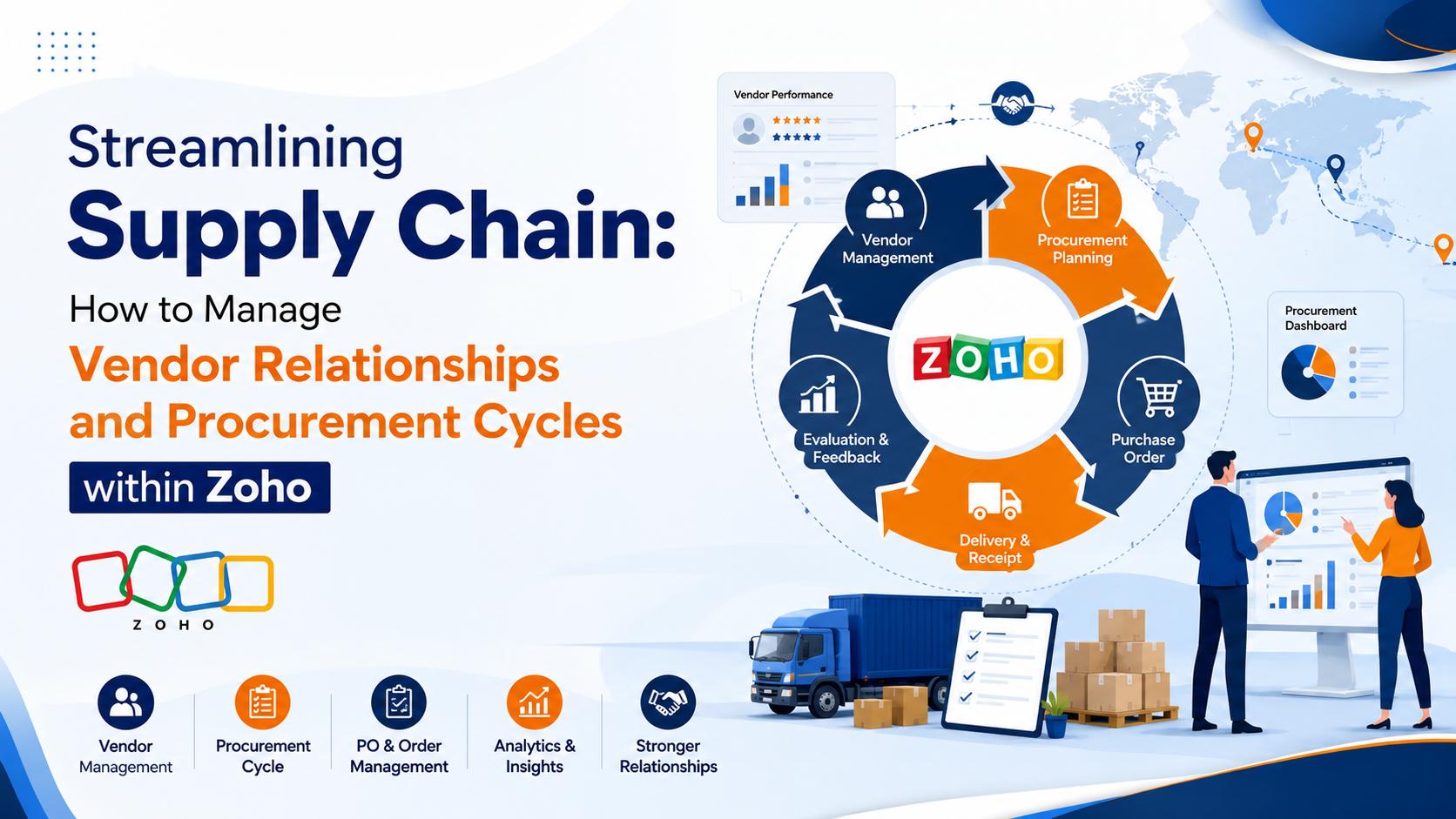
How the procurement cycle flows, start to finish
Here’s the honest version of how it works, day to day.
Someone raises a purchase requisition — say, the warehouse needs 500 units of a component. That request routes automatically to whoever needs to approve it, based on rules you set: amount thresholds, department, budget line. Once approved, it becomes a purchase order and goes straight to the vendor. No retyping. No copy-paste into a separate PO template.
The vendor accepts or rejects the PO. If they accept, delivery happens, and the warehouse marks goods received against that exact order. Then the bill gets matched against both the PO and the receipt before anyone pays a single rupee.
That matching step — comparing the order, the delivery, and the invoice — is the quiet hero here. It’s the difference between paying for what you actually received and paying for whatever someone typed into an email.
Vendor onboarding and the self-service portal
Onboarding a new supplier in Zoho usually starts with one action: add the vendor, and the system sends them an invitation to a self-service portal where they fill in their own details, bank information, and documents.
Which saves you from becoming their data-entry clerk.
Inside that vendor portal — available through Zoho Books and Zoho Procurement — suppliers can view their purchase orders, accept or reject them, upload invoices, and check exactly which bills have been paid and which are still pending. Fewer “any update on my payment?” calls. Fewer misplaced invoices. The back-and-forth that normally eats half a day just… shrinks.
And because each supplier maintains their own record, your master vendor data stays cleaner over time.
Keeping approvals from becoming bottlenecks
Approvals are where most procurement cycles quietly die. One person’s on leave, the PO sits, the vendor waits, the timeline slips.
Zoho lets you build approval workflows that match how your business actually makes decisions — hierarchical, parallel, or conditional. A ₹10,000 stationery order might auto-approve. A ₹10 lakh capital purchase might need three sign-offs in sequence. You define the logic once, and the system enforces it every time, routing each request to the right person and nudging them when they sit on it too long.
The point isn’t control for its own sake. It’s making sure the routine stuff moves fast while the big stuff still gets proper eyes on it.
Measuring vendor performance instead of guessing
You probably already have a gut feeling about which suppliers are reliable and which ones you merely tolerate. Zoho turns that gut feeling into something you can actually defend.
By tracking delivery timeliness, quality issues, complaint history, and pricing over time, you can score vendors on real criteria — not the last bad experience you happen to remember. According to a Deloitte survey, roughly two-thirds of procurement leaders report limited or no visibility beyond their tier-one suppliers. And you can’t negotiate well with suppliers you can’t see clearly.
Scorecards fix that. When a contract renewal comes up, you walk in with data. When two vendors quote for the same job, you already know which one delivered on time the last twelve orders.
One connected view, not five dashboards
Here’s the payoff that ties everything together. When procurement, inventory, and accounting sit on the same platform, a purchase order doesn’t just record a purchase — it updates expected stock, flags the budget, and feeds straight into your payables.
So when someone asks “where’s that order?”, the answer is on one screen instead of buried across three teams’ inboxes.
That single source of truth is what real-time visibility actually means. Not a fancier report. Just everyone finally looking at the same, current numbers — and making faster decisions because of it.
Why the India context changes everything
Here’s the part generic advice tends to skip.
Running procurement in India isn’t just procurement. It’s procurement plus GST-compliant purchase invoicing, plus e-way bill generation for goods movement, plus TDS on certain vendor payments, plus reconciliation that has to line up with your GSTR filings. A supply chain setup that ignores any of these creates a compliance headache three months down the line.
This is exactly where a certified Zoho partner in India earns their keep. A good implementation partner configures your GSTIN, sets state-specific tax rules, connects e-way bill workflows, and maps your purchase approvals so the numbers reconcile cleanly at filing time. They’ve already seen the edge cases — multi-godown stock, inter-state suppliers, cash-heavy vendors — because they work with Indian businesses every single day.
Zoho gives you the platform. A partner makes it fit your actual operation.
Frequently asked questions
Which Zoho product is best for procurement and vendor management?
It depends on scale. Zoho Inventory handles purchasing and vendor records for smaller operations. Zoho Procurement adds structured source-to-pay features, vendor portals, and three-way matching. For highly custom workflows, Zoho Creator lets you build a tailored procurement app. Many Indian businesses run a combination, tied into Zoho Books for accounting.
Can Zoho handle GST and e-way bills for purchases?
Yes. Zoho Books supports GST-compliant purchase invoicing, and Indian workflows can include e-way bill generation and TDS handling. Correct configuration is the catch, which is why most companies set this up with a Zoho partner rather than doing it blind.
How does a vendor portal actually help?
It lets suppliers accept or reject POs, upload invoices, update their own details, and track payment status themselves. That cuts email chains, reduces manual data entry, and keeps your vendor records accurate without extra effort from your team.
Do I really need a Zoho partner to set this up?
Not strictly — Zoho is built to be usable out of the box. But for multi-department approvals, integrations, data migration, and India-specific compliance, a partner saves months of trial and error and prevents costly misconfigurations.
How long does implementation take?
A basic setup can go live in days. A full supply chain configuration with custom approvals, integrations, and staff training usually runs a few weeks, depending on how complex your operation is.
Getting it done right
Software rarely fixes a broken process on its own. It amplifies whatever you point it at — which is why the setup matters as much as the tool itself.
If you want your vendor relationships and procurement cycles running cleanly inside Zoho, with GST and compliance built in from day one, Tech Magify — a Zoho Advanced Partner with 24+ years of experience and 500+ clients across the globe — helps Indian businesses configure, integrate, and actually operate the full Zoho supply chain. Talk to their team, and turn “we have Zoho” into “Zoho runs our procurement.”