
Why Your Legacy ERP Is Costing More Than You Think
Your finance team closes the books every month. They pull data from Tally, reconcile it against spreadsheets exported from SAP, then manually key numbers into a reporting template. The process takes days. Errors slip through. And every quarter, the same fire drill repeats.
This is the hidden cost of legacy ERP systems. Not the licence fee — that looks reasonable on paper. The real cost is the zoho erp migration you keep postponing because the existing system “works.” It works the way a patched tyre works: it gets you there, but you’re always watching for the blowout.
Financial services firms — PMS providers, AIFs, NBFCs — face particular pressure. Regulatory reporting demands are tighter. Client expectations are higher. And the patchwork of Tally plus QuickBooks plus custom Excel macros cannot scale. A financial services ERP solution built on Zoho One addresses these gaps directly.
What Zoho ERP Migration Actually Involves
Migration is not a software swap. It is a business process overhaul disguised as a technology project. That distinction matters because most failed migrations happen when teams treat it as an IT initiative alone.
A proper erp migration zoho project starts with mapping. Every data field in your legacy system needs a destination in Zoho One. Customer records, chart of accounts, open invoices, vendor master files — all of it. Teams in Mumbai and Bangalore who have run these migrations for fund managers report that mapping alone can surface years of data hygiene issues.
Data Migration and Cleansing Realities
Data migration is where projects stall. Legacy systems accumulate duplicate vendors, orphaned transactions, and inconsistent naming conventions. A client running Tally for eight years had four different spellings of the same supplier. Zoho Books will not fix that for you. You fix it before you migrate, or you carry the mess forward.
Cleansing takes time. Budget for it. The firms that skip this step end up with a shiny new ERP that produces the same unreliable reports as the old one. Proper data migration planning prevents these outcomes.
Parallel-run validation is the safety net. You run the legacy system and Zoho side by side for at least one full reporting cycle. Every number must match. If your monthly close produces different figures in Zoho Books than in your old system, you stop and investigate. No exceptions.
Legacy ERP to Zoho: The Six-Week Timeline
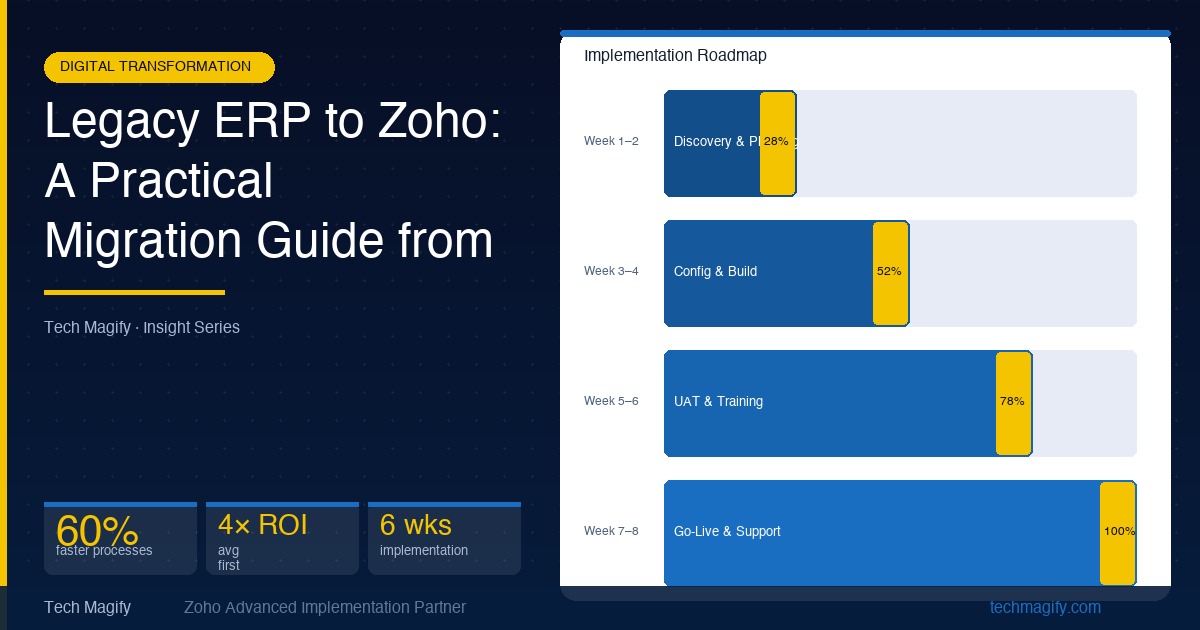
A 6-week average go-live is realistic when the scope is controlled. That timeline assumes your finance team is available for workshops, your data is exportable, and your workflows are documented. Most financial services firms meet those conditions for a successful zoho erp migration.
Week one covers discovery. What reports do you produce? Who approves expenses? How do you handle multi-entity consolidation? These answers shape the Zoho configuration.
Weeks two and three focus on data extraction and cleansing. Your IT team exports everything. The Zoho implementation partner reviews it for gaps. You fix what needs fixing.
Week four is configuration. Zoho Books gets your chart of accounts. Zoho CRM gets your client master. Zoho Projects gets your internal task structures. Workflow automation rules go in — approval chains, notification triggers, escalation paths.
Week five is parallel run. Both systems process the same transactions. Finance compares outputs. Discrepancies get resolved.
Week six is go-live and hypercare. The legacy system goes read-only. The team uses Zoho for everything. Questions get answered within hours, not days.
Why Financial Services Firms Choose a Zoho Implementation Partner
You could run this zoho erp migration yourself. Zoho documentation is thorough. But a zoho implementation partner brings pattern recognition. They have seen the same mistakes across dozens of migrations. They know which Zoho Books settings trip up NBFCs. They know how to structure Zoho CRM for relationship managers handling AIF investors.
Teams with 24+ years and 500+ clients have built playbooks for financial services ERP transitions. That experience compresses your timeline and reduces your risk.
The alternative is learning through trial and error. Your finance team becomes the test lab. Every mistake costs time, and time during erp migration zoho projects costs money.
What Changes After Your Zoho ERP Migration
The immediate win is consolidation. Three or four legacy tools become one platform. Tally goes away. QuickBooks goes away. The custom Access database your accountant built in 2011 finally retires.
Manual reconciliation drops. Firms report 40% reduction in manual reconciliation effort after moving to Zoho. Transactions flow from CRM to Books automatically. Invoices generate from project milestones. Bank feeds reconcile daily instead of monthly.
Workflow automation handles the approvals that used to require email chains. Expense claims route to the right manager based on amount thresholds. Purchase orders above a set limit trigger CFO review automatically. Nobody chases signatures.
Reporting becomes real-time. Your legacy ERP produced reports after the fact. Zoho dashboards show cash position, receivables aging, and project profitability as transactions happen. Finance stops being a rearview mirror.
The Compliance Angle for Financial Services
Regulators expect audit trails. They expect segregation of duties. They expect documented approval workflows. A properly configured Zoho implementation delivers all three out of the box.
For PMS and AIF firms, investor reporting requirements mean data must be accurate, complete, and timely. A legacy erp to zoho migration gives you the infrastructure to meet those requirements without heroic month-end efforts.
SEBI’s technology guidelines push firms toward integrated systems with proper access controls. Running financials in one system, CRM in another, and investor communications in a third creates gaps. Zoho One closes them. Working with an experienced zoho implementation partner ensures your configuration meets regulatory standards.
Making the Decision
The question is not whether your legacy ERP will eventually fail you. It will. The question is whether you migrate on your terms or in crisis mode after a regulatory finding or a client data request you cannot fulfil.
A structured zoho erp migration takes six weeks and delivers a platform that scales with your business. The Zoho consulting team handles the technical complexity while your people focus on running the business.
Your finance team deserves better than patched tyres. So does your business.
If your legacy ERP is holding back your reporting speed and accuracy, a conversation about migration timelines and scope costs nothing.