Why Spreadsheets Fail PMS Compliance
Your compliance officer pulls data from three spreadsheets, cross-references investor accounts manually, and hopes the NAV computation matches yesterday’s numbers. This workflow worked when you managed fifty portfolios. It breaks at two hundred.
SEBI compliance has tightened. Monthly reporting deadlines leave no room for manual reconciliation errors. Portfolio management software development addresses this gap by automating the workflows that consume your back-office team’s time.
The problem is not effort. Your team works hard. The problem is that manual processes do not scale. Every new investor adds complexity. Every SEBI circular adds a reporting requirement. Without systematic automation, your operational costs grow faster than your AUM.
What Portfolio Management Software Development Actually Solves
Custom software for PMS firms targets specific pain points that off-the-shelf platforms miss. Generic wealth management platform providers build for a broad market. You need software that matches your fee structures, your reporting templates, your custodian integrations.
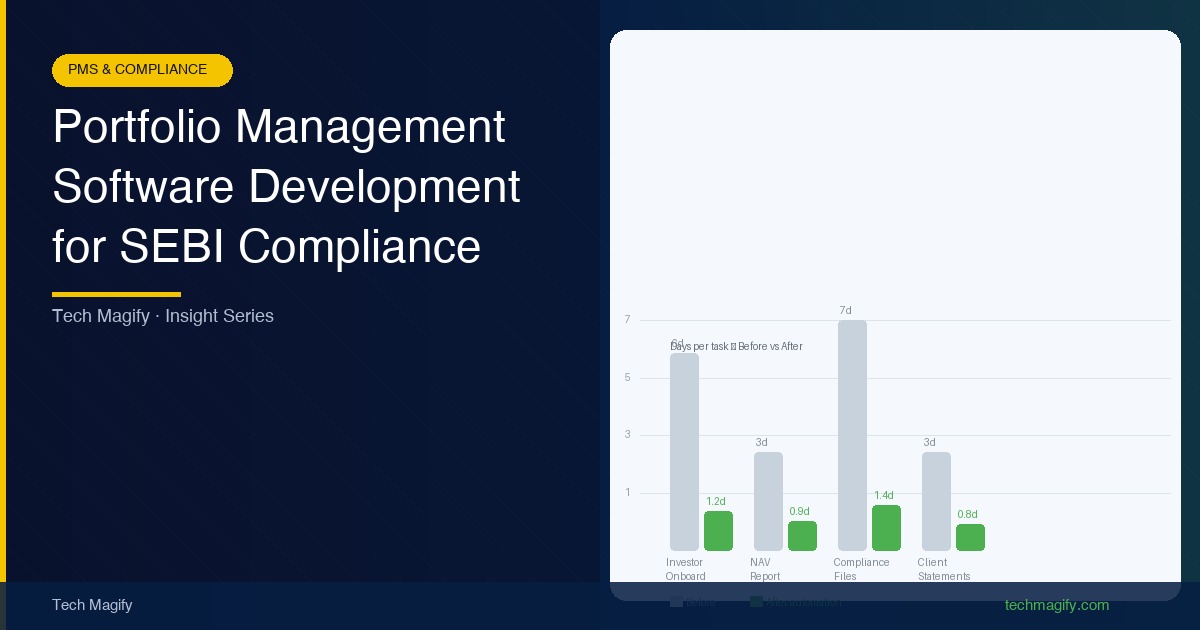
The first bottleneck is investor onboarding. SEBI mandates KYC verification, risk profiling, and agreement execution before a rupee moves. Firms using paper-based processes report onboarding times of five to seven days. Firms with automated workflows complete onboarding the same day.
The second bottleneck is NAV computation. Daily or weekly NAV requires pulling positions from custodians, applying corporate actions, calculating accrued fees, and publishing to investors. One manual step creates downstream errors. Automation eliminates the step entirely.
Automating NAV Computation Without Custom Code
You do not need a team of developers writing calculation engines from scratch. Platforms like Zoho Creator allow low-code development of NAV workflows. Pull custodian data through APIs. Apply fee logic through configured rules. Push results to investor dashboards automatically.
Teams across Mumbai have implemented this approach in six weeks. The result: 80% reduction in manual back-office tasks and month-end reporting that closes in hours rather than days.
Digital Asset Management Software Development for Growing Portfolios
As your AUM grows, so does portfolio complexity. Multi-asset strategies require tracking equities, debt, derivatives, and structured products in a single view. Digital asset management software development creates unified dashboards that show real-time positions, historical performance, and risk metrics.
SEBI requires PMS firms to provide quarterly portfolio statements to investors. Most firms generate these manually, pulling data from multiple sources and formatting reports in Excel. A custom solution generates statements automatically, reducing errors and freeing your team to focus on investment decisions.
Asset tracking software development extends this capability to operational workflows. Track custody transfers, corporate actions, and dividend credits without manual intervention. Every transaction creates an audit trail that satisfies SEBI inspection requirements.
Building Compliance Into Your Tech Stack
Compliance is not a module you bolt on. It must be embedded in every workflow. Investor communication logs must be searchable. Fee calculations must be auditable. Portfolio changes must be timestamped.
Zoho CRM serves as the investor lifecycle hub. Every interaction from the first inquiry to quarterly reviews lives in one system. Zoho Analytics transforms raw portfolio data into compliance reports that match SEBI templates. Zoho Books handles fee calculations with audit trails that regulators expect.
This approach works because these tools integrate natively. Data flows from CRM to Analytics to Books without manual exports. Your compliance team spends time reviewing reports rather than building them.
Portfolio Reporting That Satisfies Regulators and Investors
Investors expect transparency. SEBI mandates it. Your portfolio reporting must serve both audiences. Investor-facing reports need clear performance attribution and fee breakdowns. Regulator-facing reports need transaction-level detail and compliance certifications.
Custom software generates both from the same data source. No duplicate entry. No reconciliation between investor reports and regulatory filings. One source of truth that updates in real time.
Wealth Management Platform Providers vs Custom Development
Off-the-shelf platforms offer quick deployment. You pay a license fee, configure your account, and start using the software. The trade-off is flexibility. These platforms enforce their workflows on your business.
Custom portfolio management software development inverts this relationship. Your workflows drive the software design. Fee structures that generic platforms cannot handle become configuration options. Reporting formats that match your client expectations become standard outputs.
The cost comparison favours custom development for firms above a certain scale. License fees for generic platforms compound annually. Custom software has a fixed development cost with minimal ongoing fees. At three hundred portfolios, the economics shift decisively toward custom solutions.
Implementation Without Disruption
Your team cannot pause operations for a six-month implementation. Effective portfolio management software development runs parallel to existing workflows. Migrate investor data first. Test NAV calculations against current processes. Switch over when outputs match.
Teams in Bangalore have followed this approach for AIF firms managing structured products. Go-live in six weeks with zero disruption to investor reporting. Back-office automation activates incrementally as staff training completes.
The goal is not to replace your team. The goal is to give them tools that match the complexity of your business. Spreadsheets served their purpose. They cannot serve it any longer.
SEBI compliance will only tighten. Investor expectations will only increase. Portfolio management software development positions your firm to meet both demands without scaling your headcount proportionally.
PMS and AIF firms across Mumbai and Bangalore have reduced onboarding from five days to same-day completion with Zoho-based automation.