
Zoho has changed this calculus in a meaningful way. Not by positioning itself as an ERP in the traditional sense, but by delivering a suite of 55-plus interconnected business applications that, when implemented correctly, cover the full operational scope that growing businesses actually need: finance, sales, operations, HR, marketing, and customer service — all in one ecosystem, all sharing one data layer.
What Makes Zoho Different from Traditional ERP
Traditional ERP systems are monolithic. They are installed once, configured extensively, and then changed only through expensive upgrade cycles or consulting engagements. Zoho is modular and cloud-native. You can start with the applications your business needs most — typically Zoho CRM and Zoho Books — and add capabilities as the business grows.
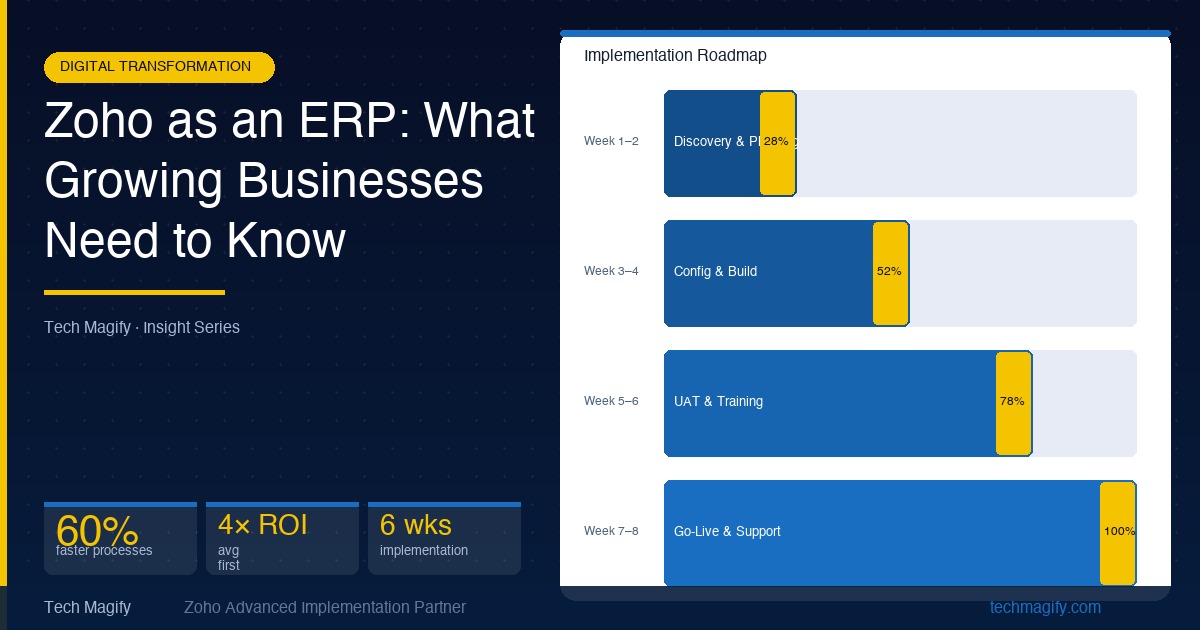
This modularity has a significant financial implication. A traditional ERP implementation for a 100-person business might cost ₹50 lakh to ₹1 crore in licensing and implementation fees before the system goes live. A Zoho One subscription covers the entire suite for a fraction of that cost, and an experienced implementation partner can have the core modules live within eight to twelve weeks for most business configurations.
The data architecture is where Zoho’s real advantage lies. Every Zoho application shares a common data layer. A lead in Zoho CRM becomes a customer in Zoho Books when a deal closes. An expense submitted in Zoho Expense flows into the accounting module automatically. An employee hired in Zoho Recruit triggers an onboarding workflow in Zoho People. These connections happen without manual data entry or custom integrations. They are built into the platform.
The Core Stack for a Growing Business
For most businesses considering Zoho as their operational backbone, the implementation typically begins with four or five foundational modules. Zoho CRM manages the sales pipeline, customer data, and post-sale relationship. Zoho Books handles accounting, invoicing, GST compliance, and financial reporting. Zoho Inventory manages stock, procurement, and fulfilment for product businesses. Zoho People covers HR, leave management, and payroll. Zoho Analytics connects to all of the above and provides unified reporting across every business function.
Once this core is in place, additional capabilities can be added without disrupting what is already working. A business that grows into e-commerce can add Zoho Commerce. One that needs a customer support operation can add Zoho Desk. One that wants to build custom internal applications can use Zoho Creator without needing to write conventional code.
Zoho and GST Compliance in India
For Indian businesses, GST compliance is a non-negotiable operational requirement. Zoho Books is built with GST compliance at its core — supporting all invoice types, HSN/SAC codes, GST returns, e-way bills, and reconciliation with the GSTN portal. The system keeps pace with regulatory changes, which means businesses do not need to worry about whether their accounting software is current with the latest GST rules.
For businesses that deal with a high volume of invoices — distributors, manufacturers, professional services firms — the automation of GST calculations and return preparation alone represents a meaningful reduction in accounting team workload and compliance risk.
What a Well-Implemented Zoho ERP Looks Like
Implementation quality is what separates a Zoho deployment that transforms a business from one that creates new problems. The most common implementation failures fall into predictable categories: the system is configured generically without adapting to how the business actually works; data is migrated from legacy systems without adequate cleaning and mapping; staff are given access to the platform without proper training and change management; and the implementation partner disappears after go-live, leaving the internal team to handle configuration issues alone.
A well-implemented Zoho system begins with a thorough process mapping exercise. Every core business workflow is documented, and the Zoho configuration is designed to match — not the other way around. Data migration is treated as a project in itself, with validation at every stage. Training is role-specific, not a generic walkthrough of the platform features. And post-go-live support is structured and accessible, because every business encounters questions and edge cases in the first months of a new system.
When Zoho Is the Right Choice — and When It Is Not
Zoho is the right choice for businesses in the ₹10 crore to ₹500 crore revenue range that need an integrated operational platform, have outgrown their current tools, and want to invest in a system that grows with them without requiring a new implementation every few years. It is particularly well-suited to professional services firms, financial services companies, technology businesses, and distribution or manufacturing operations with moderate supply chain complexity.
Zoho is not the right choice for businesses with highly specialised requirements that do not map to standard business processes — very complex manufacturing with custom shop-floor management, or multi-entity international accounting with intricate consolidation requirements. These scenarios may require platforms with deeper vertical specialisation. An honest implementation partner will tell you this before you commit to a deployment.
Making the Right Decision
The decision to replace a legacy system or consolidate disconnected tools onto Zoho is significant. It warrants a structured evaluation: a clear understanding of your current process gaps, a realistic view of what Zoho can and cannot do for your specific business, and a credible implementation plan with defined timelines and milestones.
Tech Magify has implemented Zoho across businesses in financial services, professional services, and distribution — ranging from 20-person firms taking their first step into structured CRM, to 200-person operations migrating from legacy ERP platforms. If you are evaluating Zoho for your business, book a free discovery call at bookings.techmagify.com and let us give you a straight answer on whether Zoho is the right fit and what a realistic implementation looks like.
Evaluating Zoho as your ERP? Let’s talk specifics.
We’ve helped dozens of businesses replace legacy ERP systems with Zoho. Book a free discovery call to explore what migration looks like for your firm.