
The Real Cost of Getting Compliance Wrong
\n
If you run a Portfolio Management Service in India, you already know that SEBI’s regulatory framework is not static. Between the PMS Regulations of 2020, periodic circulars on disclosure norms, performance reporting standards, and the tightening requirements around investor grievance redressal, your compliance team faces a moving target. What worked eighteen months ago may no longer be sufficient, and the margin for error is uncomfortably thin. A delayed filing, an inconsistent NAV disclosure, or a missed investor communication is not just a paperwork problem — it is an operational risk that can trigger SEBI scrutiny, reputational damage, and in severe cases, licence suspension.
\n
The uncomfortable truth is that most PMS firms still manage compliance through a patchwork of spreadsheets, email reminders, and the institutional memory of a few experienced team members. This approach barely held together when regulations were simpler and AUM thresholds were lower. At today’s scale, with SEBI expecting granular, timely, and auditable data from every registered portfolio manager, the gap between manual processes and regulatory expectations is widening every quarter.
\n\n
Where Manual Processes Break Down
\n
Consider the lifecycle of a single compliance obligation: SEBI’s requirement that PMS providers disclose strategy-level performance on a monthly basis. This involves pulling trade data from your order management system, reconciling it with custodian records, computing time-weighted returns according to SEBI’s prescribed methodology, generating the disclosure document, and publishing it within the mandated window. Each step involves a different data source, a different person, and a different potential point of failure. When one analyst is on leave, or when the custodian’s data arrives late, or when the spreadsheet formula references a wrong cell range, the entire chain stalls or produces incorrect output.
\n
Now multiply that by every compliance obligation your firm faces. Quarterly reporting to SEBI. Annual audits. KYC and AML verification at onboarding. Ongoing monitoring for changes in investor risk profile. Fee disclosure and breakup for each client. Grievance tracking and resolution within prescribed timelines. No single compliance task is impossible to do manually. The risk emerges from the sheer volume and interdependency of these tasks, all running in parallel, all subject to human error and bandwidth constraints.
\n\n
The Hidden Danger of Inconsistent Data
\n
SEBI audits do not merely check whether you filed on time. They check whether the data in your filings is internally consistent and matches the records you maintain elsewhere. If your monthly performance disclosure shows one return figure but your investor statement shows another because each was computed from a slightly different data extract, that inconsistency becomes an audit finding. Firms like Abakkus and ValueQuest understood this early: the only reliable way to ensure consistency across filings, investor communications, and internal records is to have a single source of truth that feeds every downstream output. That single source of truth cannot be a spreadsheet maintained by one person. It needs to be a system.
\n\n
What Compliance-First Technology Actually Looks Like
\n
When we talk about compliance technology at Tech Magify, we are not talking about a standalone regulatory filing tool bolted onto your existing operations. The approach that actually reduces operational risk is an integrated one, where your core portfolio management workflows — trade execution, reconciliation, NAV computation, fee calculation, investor reporting — are designed from the ground up to produce compliance-ready data as a byproduct of daily operations, not as a separate exercise done at month-end.
\n
This is what we implemented for Emkay Global and Banyan Tree Advisors using Zoho’s platform, customised to the specific regulatory context of Indian PMS operations. The portfolio accounting module feeds directly into the performance reporting engine. The investor onboarding workflow captures KYC, risk profiling, and agreement execution in a single auditable sequence. Fee calculations are locked to the methodology defined in the SEBI-registered investment agreement, eliminating the possibility of ad hoc adjustments that cannot be explained in an audit. Every data point carries a timestamp and an audit trail.
\n\n
Automating the Regulatory Calendar
\n
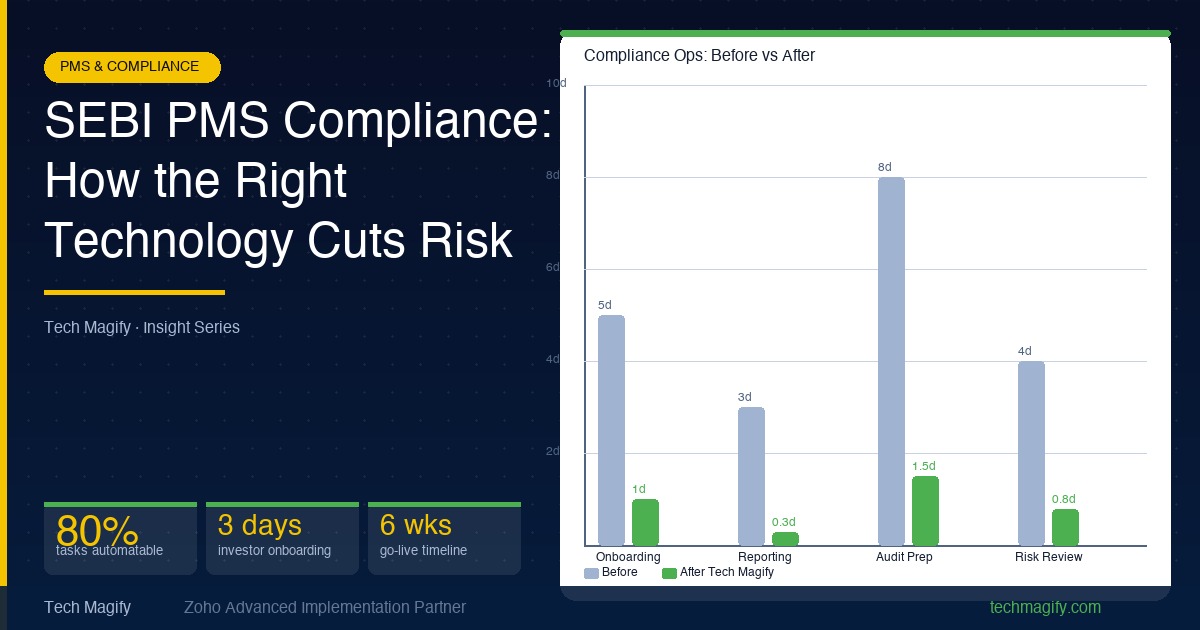
One of the most effective yet underappreciated features of a well-configured compliance system is the regulatory calendar. SEBI’s filing deadlines, disclosure windows, and periodic reporting obligations are mapped into the system with automated triggers. When a quarterly report is due, the system does not wait for someone to remember. It initiates the data pull, generates the draft, routes it for review, and flags any data anomalies before the compliance officer even opens the file. TCG adopted this approach and saw their compliance preparation time drop by more than half, because the system was doing the mechanical work that previously consumed the first week of every quarter.
\n\n
Reducing Risk Beyond Filing Deadlines
\n
Operational risk in PMS compliance extends well beyond missing a filing date. It includes the risk of onboarding an investor without proper documentation, the risk of executing trades in a strategy that breaches its stated investment restrictions, and the risk of communicating fee structures that do not match the terms registered with SEBI. Each of these risks has a technology solution that is not exotic or experimental but simply a matter of configuring proper validations and workflows in your existing operational platform.
\n
For instance, your onboarding workflow should not allow an investor account to become active until every mandatory document is uploaded, verified, and digitally signed. Your order management system should flag any trade that would cause a portfolio to breach its concentration limits or asset allocation bounds before the order reaches the exchange. Your fee engine should compute charges strictly according to the registered fee schedule, with any exception requiring multi-level approval that is logged permanently. These are not aspirational features. They are configurations that Tech Magify has deployed repeatedly across PMS firms managing collective AUM in the thousands of crores.
\n\n
Audit Readiness as a Default State
\n
The firms that handle SEBI inspections with the least stress are not the ones that scramble to assemble documentation when the notice arrives. They are the ones whose systems produce audit-ready records as part of normal operations. Every investor communication archived automatically. Every NAV computation traceable to its underlying trades. Every compliance decision documented with the rationale and the approving officer. When your system maintains this level of discipline by design, an audit becomes a retrieval exercise rather than a reconstruction exercise. That difference is not trivial. It is the difference between a two-day audit and a two-month ordeal.
\n\n
\”We stopped thinking of compliance as a separate function. Once Tech Magify integrated it into our daily workflows on Zoho, compliance became something the system handles, not something the team dreads.\” — Operations Head, Banyan Tree Advisors
\n\n
Why This Matters Now More Than Ever
\n
SEBI has made its direction unmistakably clear over the past three years. Disclosure standards are rising. Reporting granularity is increasing. The regulator is investing in its own technology to cross-reference filings, detect anomalies, and identify firms that are not keeping pace. The cost of non-compliance is not just the penalty amount stated in the circular. It is the reputational erosion, the investor attrition, and the management bandwidth consumed by remediation that could have been spent on growing the business.
\n
Your firm does not need to build a technology team from scratch to address this. What you need is an implementation partner who understands both the regulatory requirements and the operational reality of running a PMS in India, and who can configure a system that handles compliance as a natural extension of your investment operations. That is precisely the work Tech Magify does, and it is why firms like Abakkus, Emkay Global, TCG, ValueQuest, and Banyan Tree Advisors chose to work with us. The regulatory environment will only get more demanding. The question is whether your operations are built to keep up.
“,”cta_headline”:”Make SEBI Compliance a System, Not a Scramble”,”cta_body”:”Tech Magify configures Zoho-based compliance workflows purpose-built for Indian PMS regulations, so your team stops chasing deadlines and starts operating with audit-ready confidence. Book a 30-minute consultation to see exactly how your compliance gaps can be closed.”}
Eliminate SEBI Compliance Gaps Before Your Next Audit
Tech Magify has helped firms like Abakkus and ValueQuest build compliance workflows that run without manual intervention. Book a 30-minute call to see exactly where your current PMS operations carry unnecessary regulatory risk.