Running a SEBI-registered AMC in India has never been more operationally demanding. Between NAV reconciliation, investor communication, SEBI filings, and the growing volume of unit-holder queries, fund operations teams are stretched thin — and the data is scattered across disconnected spreadsheets, emails, and legacy systems. Most AMCs we speak with are not short on intelligence. They are short on time and integration.
This post examines how India’s forward-thinking asset management companies are addressing this gap with Zoho’s integrated ecosystem, and how the shift from manual processes to automated fund operations is playing out on the ground in 2026.
The Operational Reality of Running an AMC in 2026
India’s mutual fund industry crossed ₹65 lakh crore in AUM in 2025. That growth brings with it a proportional increase in operational complexity. The number of unit-holder folios has more than doubled in three years. SEBI’s disclosure requirements have grown more granular. And investors, particularly HNI and family office investors, now expect real-time portfolio transparency.
Yet the back-office at many mid-sized AMCs still operates much as it did a decade ago. NAV computation files travel over email. Compliance checklists live in Excel. Investor queries are handled through a mix of WhatsApp and manual email responses. New distributor onboarding takes days, sometimes longer.
The gap between what investors now expect and what fund operations teams can deliver is closing, but slowly. Technology is the differentiator. And for Indian financial services firms, Zoho has emerged as the platform of choice when implemented with the right expertise.
Where Zoho Fits into the AMC Operating Model
Zoho’s ecosystem was not built specifically for fund houses, but when implemented with financial services expertise, it maps cleanly onto the core AMC operating model. The modules that deliver the most impact across fund operations are Zoho CRM, Zoho Creator, and Zoho Books, often combined with custom Deluge automation scripts that tie the pieces together.
Zoho CRM for Investor and Distributor Relationship Management
Every AMC manages two sets of relationships simultaneously: investors (unit-holders, HNIs, institutional clients) and distributors (MFDs, RIAs, IFAs). These are operationally distinct but data-linked. A well-configured Zoho CRM gives fund relationship managers a unified view of both.
In practice, this means each investor’s portfolio snapshot, communication history, KYC status, and pending redemption requests are visible in one place. Distributor performance is tracked at the ARN code level, with automated alerts when a distributor’s AUM drops below a threshold or SIP activation rates fall. Communication, whether a portfolio review, a dividend announcement, or a scheme update, is scheduled and tracked from the same system.
AMC teams using Zoho CRM report that their relationship managers spend significantly less time pulling data and far more time actually engaging with investors and distributors. Firms like Emkay Global have already deployed Zoho CRM to streamline their client relationship infrastructure, and the same architecture applies directly to the AMC context.
Zoho Creator for Custom Fund Operations Workflows
Not every AMC operation fits into an out-of-the-box SaaS product. This is precisely where Zoho Creator, Zoho’s low-code application development platform, earns its place in fund operations.
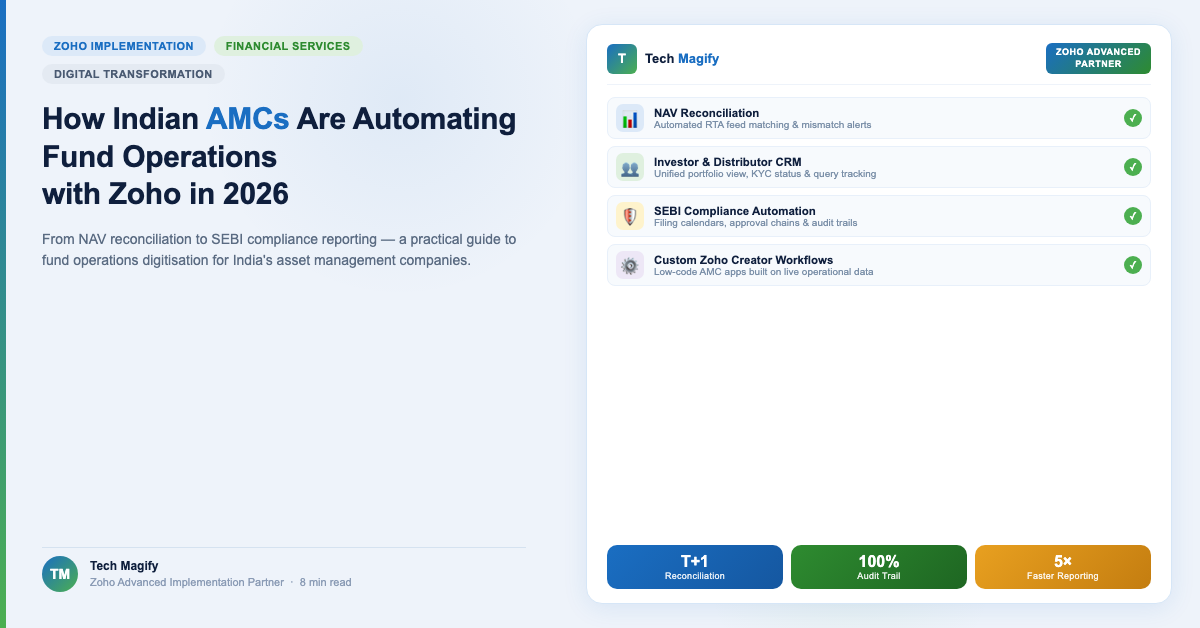
Fund operations teams at AMCs have used Creator to build NAV reconciliation dashboards that pull data from RTA feeds and flag mismatches automatically, compliance checklists linked to SEBI reporting calendars with automated reminders to relevant team members, investor onboarding workflows that route KYC documents through a defined approval chain, and internal SLA tracking tools for unit-holder service requests so that no query falls through the cracks.
What makes Creator particularly valuable for AMCs is that these applications are built on data that already exists in the Zoho ecosystem. There is no duplication, and no separate database to maintain. Every trigger, every automation, every notification runs through the same logical infrastructure, giving your operations team a single source of truth rather than a collection of disconnected tools.
Zoho Books for Financial Operations and Expense Management
AMC back-offices also carry significant financial operations workloads. Management fee calculations, expense accruals, vendor payments, and audit-ready reporting are all part of the monthly cycle. Zoho Books handles these workflows cleanly. For AMCs that are subsidiaries of larger financial groups, Books integrates with Zoho’s broader ERP stack, enabling consolidated reporting across entities without the need for manual data exports and reconciliation.
A Real-World Workflow: Automated Investor Query Resolution
Consider a common AMC scenario. An HNI investor sends a query about the redemption status of a recent folio request. Under a manual workflow, the query reaches an inbox, gets forwarded to operations, operations checks the RTA system, writes back to the relationship manager, who writes back to the investor. Elapsed time: twelve to twenty-four hours on a good day.
With a Zoho-integrated workflow, the same query reaches the CRM as a case. The case is auto-tagged based on keyword detection. A Deluge script queries the integrated RTA data and populates the case with the current redemption status. The relationship manager reviews, adds context if needed, and responds with one click. Elapsed time: under thirty minutes. The interaction is logged, the investor satisfaction score is tracked, and the data is available for performance review.
This is not a futuristic scenario. Tech Magify has built comparable query management workflows for financial services firms including Emkay Global and Banyan Tree Advisors, and the same architecture applies directly to AMC operations teams managing high volumes of unit-holder communication.
SEBI Compliance Readiness as an Outcome, Not an Afterthought
One dimension of fund operations automation that often gets undervalued is its effect on compliance readiness. When operational data is centralised in a connected system, generating audit-ready reports is no longer a scramble before inspection. It is a matter of running a query.
AMCs that have digitised their investor communication logs, distributor interaction records, and internal approval chains are in a materially better position during SEBI inspections. The question “show us all communications to this investor regarding this scheme in the past eighteen months” has a straightforward answer when the data lives in a CRM rather than across three email accounts and a shared WhatsApp group.
SEBI’s increasing focus on investor grievance redressal timelines and distributor conduct documentation makes this compliance dividend even more relevant. Your fund operations platform should be generating the audit trail as a by-product of normal operations, not as a manual exercise before every review.
The NAV Reconciliation Problem and How Automation Solves It
NAV reconciliation is one of the most time-critical and error-prone processes in AMC operations. Any mismatch between the AMC’s books and the RTA’s records needs to be identified and resolved before cut-off. Under manual workflows, this means operations staff downloading files, running VLOOKUP formulas, and emailing discrepancy lists to fund accounting. The process is slow, and the risk of a missed mismatch is real.
A Zoho Creator application built for NAV reconciliation automates the file ingestion, runs the comparison logic, and surfaces mismatches in a flagged queue for your operations team to action. The reconciliation dashboard shows which folios have discrepancies, what the variance is, and who is responsible for resolution. Completed reconciliations are logged with a timestamp and the name of the approving officer, giving you a clean audit trail for every T+1 cycle.
The result is that your operations team moves from spending three hours on reconciliation to spending thirty minutes on exception handling. The data entry and comparison work is done by the system; your team focuses on judgment calls.
Choosing the Right Implementation Partner for Your AMC
Deploying Zoho for an AMC is not a self-service exercise. The configuration depth required, including custom Deluge workflows, RTA data integrations, SEBI calendar automations, and multi-entity reporting structures, demands a partner who understands both the Zoho platform and the operational reality of a regulated fund house.
Tech Magify works exclusively with financial services firms. The team understands what a T+3 reconciliation cycle looks like, why distributor commission management requires careful data governance, and what SEBI’s inspection process actually looks for. That context shapes every implementation decision, from how data models are structured to which workflow triggers are built as automation versus manual review steps.
For AMCs evaluating their technology roadmap, the right question is not “should we digitise fund operations?” The answer to that is already clear. The right question is “which platform and which partner will give us the operational efficiency, the compliance readiness, and the scalability to grow without adding proportional back-office headcount?” That is the conversation Tech Magify has with every AMC team we work with.
What a Digitised AMC Operations Stack Looks Like in Practice
To make this concrete, here is what a fully integrated Zoho stack looks like for a mid-sized AMC managing three to five schemes with a growing HNI investor base.
Zoho CRM holds the investor and distributor master data, with custom fields mapped to SEBI-required KYC attributes. Every investor interaction, whether a phone call, an email, or a physical meeting, is logged against the contact record. Portfolio data is pulled in from the RTA feed at a scheduled interval, so relationship managers always have an up-to-date view when speaking with investors.
Zoho Creator runs the operational workflows: NAV reconciliation, investor onboarding approvals, complaint tracking, and compliance calendar management. Custom dashboards give the operations head and compliance officer a real-time view of open items, SLA breaches, and upcoming regulatory deadlines.
Zoho Books manages the financial operations layer: expense tracking, management fee calculations, vendor payments, and the monthly close process. All three systems are connected through Zoho’s native integration layer, with Deluge scripts handling any custom logic at the boundaries.
The result is a fund operations infrastructure that scales with your AUM without requiring you to scale your team at the same rate.
India’s AMC industry is entering a phase of significant growth, and the firms that build the right operational foundation now will be better positioned to capture that growth without being slowed down by back-office complexity. Zoho, implemented with the right financial services expertise, is that foundation for an increasing number of India’s fund houses.
If your AMC is evaluating how to modernise fund operations, book a free discovery call with the Tech Magify team at bookings.techmagify.com.