
The conversation around artificial intelligence in business has been dominated by extremes. On one side, predictions of wholesale transformation that make every existing business process sound obsolete. On the other, scepticism from executives who have watched technology vendors oversell capabilities for years. Neither position is particularly useful for a business leader trying to make practical decisions about where AI can create real value in their operations.
The honest picture is more specific than either camp suggests. AI is delivering clear, measurable results in a defined set of business contexts right now. The firms benefiting most are not the ones that committed to sweeping AI transformation programmes — they are the ones that identified two or three high-volume, repetitive processes and applied AI tools to those specific problems.
Where AI Is Delivering Genuine Value Today
The business processes where AI tools are generating consistent, documented results tend to share a common characteristic: they involve high volumes of structured or semi-structured information that humans currently process manually. These include: lead scoring and sales prioritisation, intelligent document processing, automated data entry and validation, predictive analytics for inventory or cash flow, customer sentiment analysis, and email and communication classification.
Each of these applications replaces or augments a task that currently consumes human time without requiring human judgement. A sales team spending three hours per week manually reviewing leads and assigning priority can replace that process with a scored, ranked lead list generated automatically. An operations team manually processing invoices from suppliers can use intelligent document processing to extract, validate, and route invoice data without human touch on straightforward transactions.
AI in Financial Services: Where the Applications Are Clearest
Financial services firms — PMS providers, AIFs, wealth managers, and NBFCs — operate in an environment where the case for AI-assisted automation is particularly compelling. The data volumes are high, the regulatory demands on documentation are strict, and the cost of errors is significant.
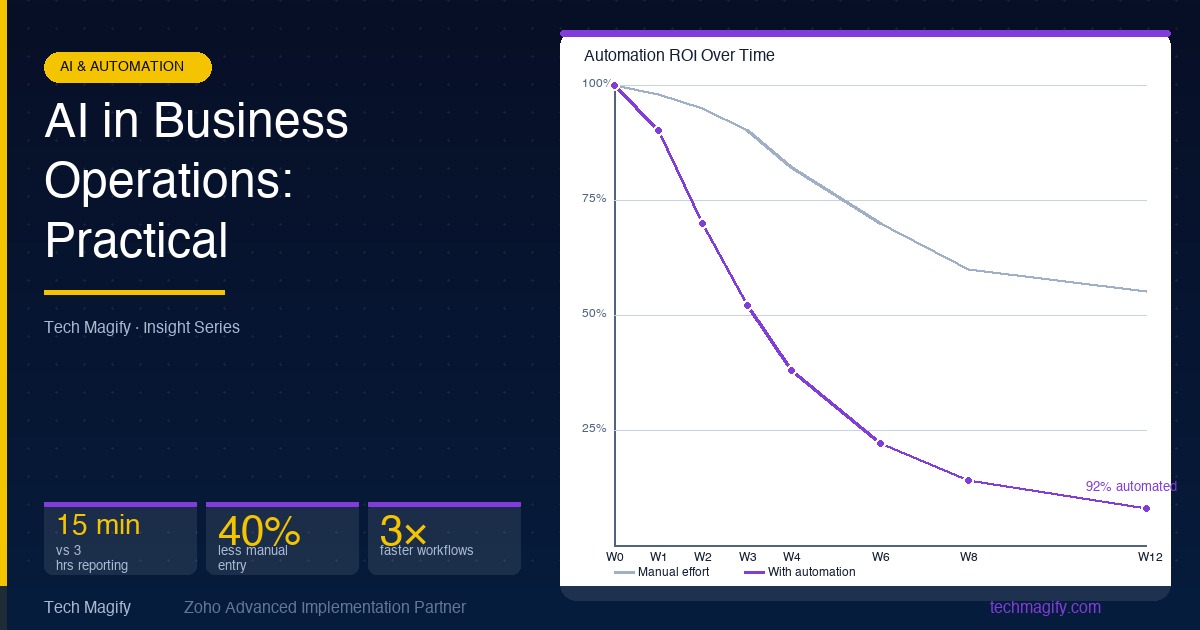
Automated investor reporting uses AI to generate personalised portfolio performance reports, pulling data from multiple sources, applying the correct calculations, and formatting the output to individual investor preferences — without manual assembly. What once required two days of operations team work per quarter now takes two hours of review time.
Intelligent client communication tools analyse the history of interactions with each investor or prospect and surface the most relevant next action for the relationship manager. Which client has not been contacted in 60 days? Which investor has just received a statement and typically calls with a question? These signals exist in the data; AI makes them actionable.
Firms like Emkay Global are among those that have begun deploying AI-assisted tools within their CRM and operations infrastructure, using Zoho’s built-in AI capabilities — Zoho Zia — to surface insights and automate routine tasks without building custom AI infrastructure from scratch.
Zoho’s AI Capabilities — What Is Actually Useful
For businesses already operating on the Zoho platform, AI capabilities are available without additional infrastructure investment. Zoho Zia, the AI layer embedded across the Zoho suite, delivers a range of capabilities that are immediately useful for most organisations.
In Zoho CRM, Zia provides lead and deal scoring based on historical conversion patterns, suggests the optimal time to contact a prospect, detects anomalies in sales data, and surfaces insights about pipeline health that would otherwise require manual analysis. In Zoho Books, AI-assisted categorisation reduces the time spent on transaction matching and reconciliation. In Zoho Desk, AI-powered ticket routing and sentiment analysis helps customer support teams prioritise responses and reduce resolution times.
These are not experimental features. They are production capabilities available within the standard Zoho subscription, requiring configuration rather than development. The implementation work involves training the system on historical data, configuring the scoring models to reflect the specific business context, and building the workflows that act on AI-generated insights.
Intelligent Document Processing: The High-Value Application for Operations Teams
For businesses that process large volumes of documents — invoices, contracts, compliance filings, client onboarding forms — intelligent document processing represents one of the highest-return AI applications available today. The technology uses machine learning to extract structured data from unstructured documents, validate it against expected formats and values, and route it into downstream systems without human intervention on clean transactions.
In a financial services context, this means KYC documents submitted by investors can be processed automatically, with exceptions flagged for human review. In a distribution business, supplier invoices can flow from email receipt to purchase order matching to accounting entry without anyone touching a keyboard. The ROI is direct and measurable: fewer hours, fewer errors, faster cycle times.
The Right Way to Start with AI
The businesses that struggle with AI adoption typically make one of two mistakes. They start too broadly — commissioning a sweeping AI strategy that tries to transform everything at once and produces complexity without results. Or they start too technically — investing in AI infrastructure and data science capability before they have identified the specific business problems that AI should solve.
The productive approach starts with process. Identify the three most repetitive, high-volume processes in your operations. Assess whether those processes involve data that AI tools can act on. Then build the smallest viable deployment — a single workflow, a single scoring model, a single document type — and measure the result before expanding.
Tech Magify helps businesses navigate exactly this process: identifying where AI creates genuine value in your specific operation, deploying Zoho’s AI capabilities (and custom AI workflows where warranted) on those targeted processes, and measuring the results rigorously. If you want a practical conversation about where AI fits in your business rather than a vendor pitch, book a free discovery call at bookings.techmagify.com.
Curious what AI automation looks like in your workflow?
Tech Magify builds AI-enhanced workflows on the Zoho platform — practical automation that fits regulated environments. Book a free discovery call.