
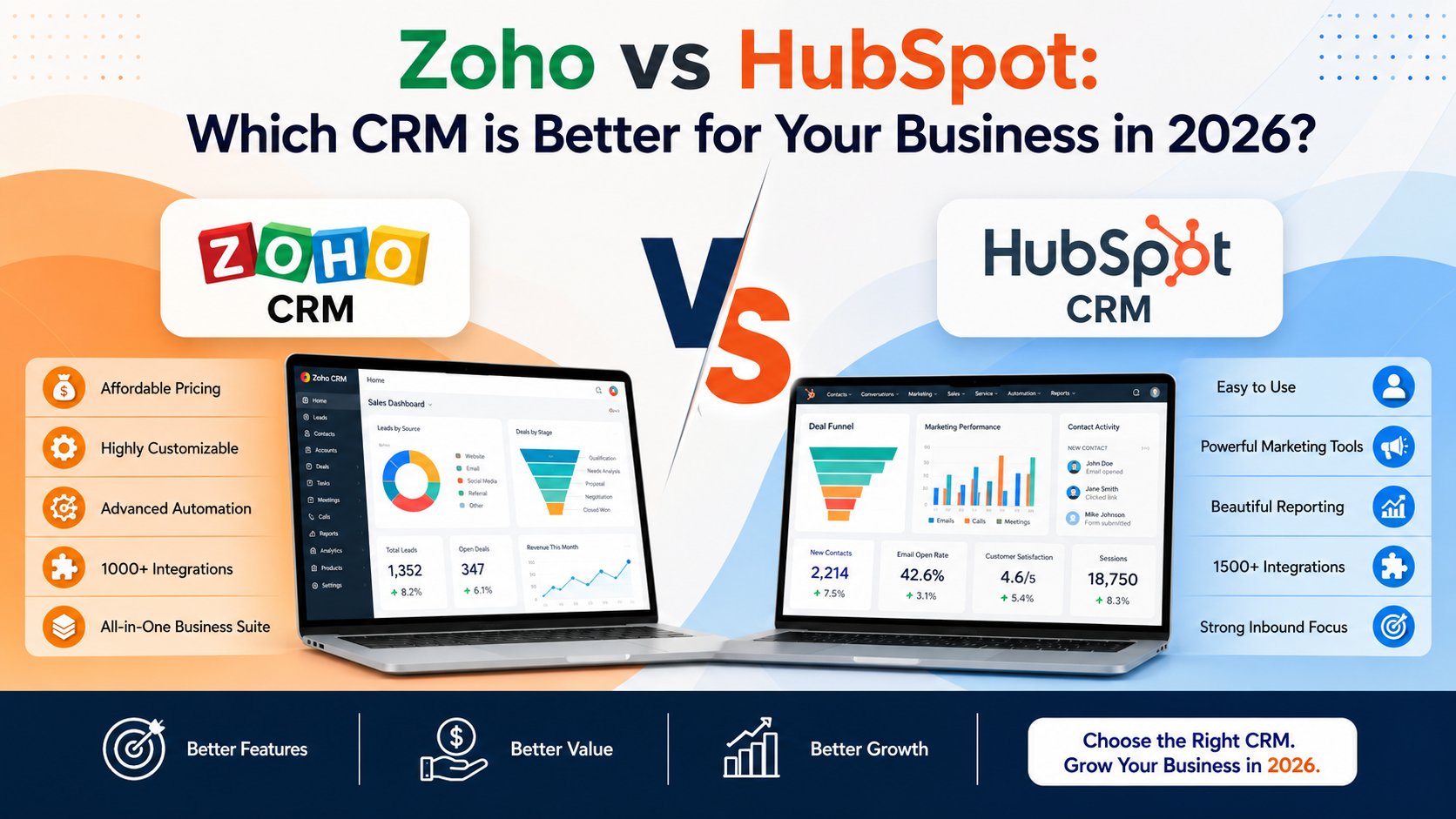
Choosing the right CRM can directly impact your sales, marketing, customer support, and overall business growth. Two of the most popular CRM platforms in the market today are Zoho CRM and HubSpot CRM. Both offer powerful features, automation tools, and integrations, but they serve different business needs.
If you’re comparing Zoho vs HubSpot, this guide will help you understand the key differences, pricing, features, advantages, and which platform is best for your business.
Quick Comparison: Zoho vs HubSpot
| Feature | Zoho CRM | HubSpot CRM |
|---|---|---|
| Best For | Small & Medium Businesses | Growing Businesses & Enterprises |
| Pricing | More Affordable | Higher Cost |
| Free Plan | Available | Available |
| Sales Automation | Advanced | Advanced |
| Marketing Tools | Good | Excellent |
| Customization | Highly Flexible | Moderate |
| Third-Party Integrations | 1,000+ | 1,500+ |
| Ease of Use | Moderate Learning Curve | Beginner Friendly |
| AI Features | Zia AI | Breeze AI |
| Customer Support | Multiple Plans | Premium Support Options |
What is Zoho CRM?
Zoho CRM is a cloud-based customer relationship management platform designed to help businesses manage leads, sales pipelines, customer interactions, and workflows from a single dashboard.
It is widely used by startups, SMEs, agencies, and service-based businesses because of its affordability and extensive customization options.
Key Features of Zoho CRM
- Lead Management
- Sales Automation
- Workflow Automation
- Email Marketing Integration
- AI Assistant (Zia)
- Omnichannel Communication
- Advanced Analytics
- Custom Modules
- Inventory Management
- Integration with Zoho Ecosystem
Pros of Zoho CRM
Budget-friendly pricing
Highly customizable
Strong automation capabilities
Large suite of business applications
Suitable for scaling businesses
Cons of Zoho CRM
Interface can feel complex initially
Setup requires technical expertise
Advanced features need higher-tier plans
What is HubSpot CRM?
HubSpot CRM is a customer platform that combines CRM, marketing, sales, customer service, and content management tools in one ecosystem.
HubSpot is known for its clean interface, user-friendly experience, and powerful inbound marketing capabilities.
Key Features of HubSpot CRM
- Contact Management
- Sales Pipeline Tracking
- Email Marketing
- Marketing Automation
- Lead Scoring
- Customer Service Hub
- Content Management System
- AI Tools
- Reporting Dashboard
- Meeting Scheduling
Pros of HubSpot CRM
Easy to use
Excellent marketing automation
Powerful reporting
Strong content marketing tools
Quick implementation
Cons of HubSpot CRM
Expensive as business grows
Advanced automation requires premium plans
Limited customization compared to Zoho
Zoho vs HubSpot: Feature-by-Feature Comparison
1. Ease of Use
HubSpot is generally considered easier for beginners. Its clean interface allows teams to get started quickly without extensive training.
Zoho CRM offers more flexibility but may require additional setup and onboarding.
Winner: HubSpot
2. Pricing
Pricing is one of the biggest factors when comparing Zoho CRM vs HubSpot.
Zoho CRM Pricing Benefits
- Lower monthly costs
- Affordable upgrades
- Better value for small businesses
- Extensive features at lower tiers
HubSpot Pricing Benefits
- Generous free plan
- Strong starter tools
- Premium functionality for larger teams
However, HubSpot’s costs can increase significantly as your database and user count grow.
Winner: Zoho CRM
3. Sales Automation
Both CRMs provide automation tools for lead assignment, follow-ups, workflow creation, and pipeline management.
Zoho CRM offers deeper workflow customization and advanced automation options.
Winner: Zoho CRM
4. Marketing Automation
HubSpot is widely recognized for its marketing capabilities.
Businesses can manage:
- Landing Pages
- Email Campaigns
- Lead Nurturing
- SEO Recommendations
- Marketing Analytics
- Blog Management
All from one platform.
Winner: HubSpot
5. Customization
Customization is an area where Zoho CRM stands out.
Users can create:
- Custom Modules
- Custom Fields
- Custom Dashboards
- Custom Workflows
- Industry-Specific Processes
This flexibility makes Zoho suitable for businesses with unique requirements.
Winner: Zoho CRM
6. AI Capabilities
Both platforms now offer AI-powered features.
Zoho Zia AI
- Sales forecasting
- Lead scoring
- Sentiment analysis
- Predictive analytics
HubSpot AI Tools
- Content generation
- Email assistance
- Meeting summaries
- Marketing recommendations
Winner: Tie
7. Reporting and Analytics
HubSpot provides visually appealing dashboards and reports that are easy to understand.
Zoho CRM offers deeper customization for advanced reporting.
Winner: Depends on Business Needs
- Simplicity: HubSpot
- Advanced Custom Reports: Zoho
Zoho vs HubSpot for Small Businesses
For startups and small businesses, budget and flexibility are often the top priorities.
Zoho CRM provides:
- Lower operating costs
- Greater customization
- Better scalability for cost-conscious teams
HubSpot works well for businesses focused heavily on inbound marketing and content-driven growth.
Recommended Choice
| Business Type | Recommended CRM |
|---|---|
| Startup | Zoho CRM |
| Agency | Zoho CRM |
| SaaS Company | HubSpot |
| Marketing Team | HubSpot |
| Service Business | Zoho CRM |
| Enterprise | Depends on Requirements |
When Should You Choose Zoho CRM?
Choose Zoho CRM if you need:
- Affordable CRM software
- Advanced workflow automation
- Deep customization
- Integration with Zoho applications
- Better long-term cost efficiency
When Should You Choose HubSpot CRM?
Choose HubSpot CRM if you need:
- Easy implementation
- Strong marketing automation
- Content marketing tools
- User-friendly dashboards
- Fast onboarding
Final Verdict: Zoho vs HubSpot
Both Zoho CRM and HubSpot CRM are excellent platforms, but the right choice depends on your business goals.
If affordability, flexibility, and customization are your priorities, Zoho CRM is often the better investment. Businesses that require advanced workflow automation and complete control over their CRM processes typically prefer Zoho.
If your primary focus is inbound marketing, content creation, and ease of use, HubSpot may be the better fit despite its higher cost.
For most small and medium-sized businesses looking for a scalable and cost-effective CRM solution, Zoho CRM offers exceptional value and long-term flexibility.
Need Help with Zoho CRM Implementation?
Implementing Zoho CRM correctly is just as important as choosing the right platform. A poorly configured CRM can lead to low adoption, inefficient workflows, and missed business opportunities.
As an experienced Zoho Implementation Partner, TechMagify helps businesses successfully deploy, customize, migrate, and optimize Zoho CRM according to their unique requirements.
TechMagify provides:
- Zoho CRM Setup & Configuration
- CRM Migration Services
- Workflow Automation
- Custom Module Development
- Zoho Integrations
- User Training & Support
- Ongoing CRM Optimization
Whether you’re switching from HubSpot, upgrading your current CRM, or implementing Zoho for the first time, TechMagify can help you maximize your CRM investment and improve business efficiency.
FAQs: Zoho vs HubSpot
1. Which is better, Zoho CRM or HubSpot CRM?
The better CRM depends on your business needs. Zoho CRM is ideal for companies looking for affordability, customization, and automation, while HubSpot CRM is better for businesses focused on marketing and ease of use.
2. Is Zoho CRM cheaper than HubSpot?
Yes. Zoho CRM is generally more affordable than HubSpot, especially for small and medium-sized businesses that need advanced CRM features without high monthly costs.
3. Can I migrate from HubSpot to Zoho CRM?
Yes. Businesses can migrate contacts, deals, emails, workflows, and other CRM data from HubSpot to Zoho CRM using migration tools or a Zoho implementation partner.
4. Which CRM is best for small businesses?
Zoho CRM is often the preferred choice for small businesses because it offers strong automation, customization, and lower pricing compared to HubSpot.
5. Does Zoho CRM offer marketing automation?
Yes. Zoho CRM integrates with Zoho Marketing Automation and other Zoho applications to help businesses manage email campaigns, lead nurturing, and customer engagement.
6. Is HubSpot CRM free to use?
HubSpot offers a free CRM plan with basic sales and contact management features. However, advanced marketing and automation tools require paid subscriptions.
7. Which CRM has better customization options?
Zoho CRM provides more customization options, including custom modules, workflows, fields, layouts, and automation rules, making it suitable for businesses with unique processes.
8. Does Zoho CRM have AI features?
Yes. Zoho CRM includes Zia AI, which helps with lead scoring, sales predictions, workflow suggestions, sentiment analysis, and business insights.
9. Which CRM is easier to learn and use?
HubSpot CRM is generally easier for beginners because of its clean interface and simple setup process. Zoho CRM may require more initial configuration but offers greater flexibility.
10. Why should I work with a Zoho Implementation Partner?
A Zoho Implementation Partner can help with CRM setup, customization, data migration, automation, integrations, user training, and ongoing support, ensuring you get the maximum value from your Zoho investment.