
The Compliance Mess Most Fund Managers Live With
You are running a Category II or Category III AIF. SEBI wants quarterly reports. Investors want capital call notices on time. Auditors want a trail they can follow without sending you twelve follow-up emails.
And you are managing all of this across spreadsheets, a CRM that nobody updates, and an inbox that doubles as your compliance archive. It is not sustainable. One missed drawdown notice and your investor relationship takes a hit. One late SEBI filing and the regulator starts asking questions.
This is where asset tracking software development changes the equation. Not an off-the-shelf tool that forces you to adapt. A system built around how your fund actually operates.
Why Generic Tools Fail SEBI AIF Operations
Most fund managers start with a mix of accounting software, a basic CRM, and maybe a project management tool for compliance calendars. Sounds reasonable. Except none of these systems talk to each other.
Your compliance officer tracks SEBI AIF deadlines in one place. Your investor relations team sends capital call notices from another. Your finance team reconciles drawdown management in a third. When audit season arrives, someone spends two weeks pulling data from five different sources.
Digital asset management software development solves this by designing systems where data flows from one function to the next. An investor commits capital. The system logs it. A capital call goes out. The system tracks responses. A drawdown happens. The system updates fund accounting. No manual re-entry. No version control nightmares.
What SEBI AIF Reporting Actually Requires
SEBI AIF regulations demand quarterly reporting, annual audits, and specific disclosures around fund performance and investor holdings. The pain is not the complexity. It is the repetition.
Every quarter, you pull the same data, format it the same way, and submit it through the same portal. A well-designed asset management system ui design automates the data pull and pre-formats reports. Your team reviews and submits instead of building from scratch each time.
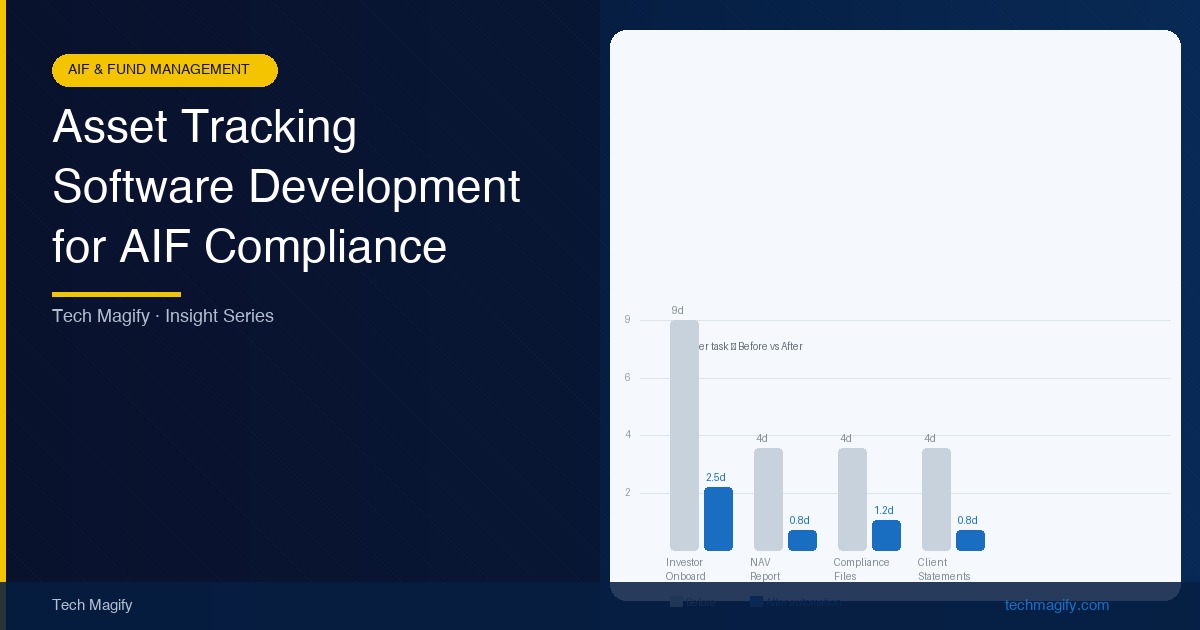
Teams in Mumbai and Bangalore have run full Zoho-based implementations for fund managers. The result: 60% reduction in compliance prep time. That is not a marginal improvement. That is getting two weeks back every quarter.
Asset Tracking Software Development That Actually Works
Custom asset management software design starts with understanding your fund structure. How many schemes do you run? How many investors per scheme? What is your capital call frequency? How do you handle drawdown management across tranches?
A Zoho-based AIF stack covers four core functions. First, an investor portal built on Zoho Creator. Investors log in, see their commitments, track capital calls, and download statements. No more email chains asking for the same PDF.
Second, a compliance calendar on Zoho Projects. Every SEBI AIF deadline, every audit milestone, every internal review gets tracked with owners and due dates. Nothing slips through because someone forgot to check their calendar.
Third, investor communication through Zoho CRM and Campaigns. Capital call notices, fund performance updates, and ad-hoc announcements go out from one place. Every interaction is logged. When an investor calls, your team knows exactly what they have received and when.
Fourth, fund accounting integration with Zoho Books. Drawdowns, management fees, and expense allocations flow into your books without manual journal entries. Reconciliation happens weekly instead of quarterly.
How Investor Communication Improves with Integration
Most fund managers underestimate how much time goes into investor communication. It is not just sending updates. It is tracking who opened what, following up on capital call responses, and answering the same questions repeatedly.
A proper asset tracking software development approach creates templates for every standard communication. Capital call notices pull data directly from your investor records. Fund reporting goes out with personalised holdings data. The system logs opens and clicks. Your investor relations team sees who needs a follow-up call.
This is not about automation for its own sake. It is about giving your team the context they need to have better conversations. When an investor calls, you already know they have not opened the last three emails. You handle the call differently.
Asset Management Software Design That Scales
Most funds start small. Maybe twenty investors across two schemes. Five years later, you are managing eighty investors across six schemes. The spreadsheet that worked at twenty investors becomes a liability at eighty.
Single platform replacing 4-5 tools sounds like marketing speak until you have lived through a system migration. Every tool you add is another integration to maintain, another login to manage, another place where data can go stale.
The fund managers who plan ahead invest in asset tracking software development early. They build on a platform that scales. They design data structures that accommodate new schemes without rebuilding from scratch. They create user roles that let junior team members handle routine tasks while senior staff focus on exceptions.
Teams across Pune, Hyderabad, and Chennai have implemented Zoho-based fund management systems that grow with the fund. The architecture matters more than the features on day one.
What Asset Tracking Software Development Implementation Looks Like
A typical AIF digitisation project runs eight to twelve weeks. The first two weeks focus on mapping your current workflows. Where does data live today? What are the handoffs between teams? Where do things fall through the cracks?
The next four weeks cover system configuration. Building the investor portal, setting up the compliance calendar, configuring CRM workflows, and connecting fund accounting. This is not drag-and-drop work. It requires understanding both digital asset management software development best practices and the regulatory requirements.
The final four weeks focus on testing, training, and go-live support. Your team needs to trust the system before they abandon the old way. That means running parallel processes for a month, validating fund reporting outputs, and building confidence.
The teams who have delivered these implementations bring both Zoho expertise and AIF domain knowledge. You do not want a technology partner who needs you to explain what a capital call is.
The Real Cost of Waiting on Asset Tracking Software Development
Every quarter you delay is another quarter of manual compliance prep. Another round of investor complaints about slow responses. Another audit where you scramble to produce documentation that should be one click away.
The fund managers who invest in asset management software design now will spend the next five years compounding those efficiency gains. The ones who wait will keep losing hours to work that a well-designed system handles automatically.
Your SEBI AIF compliance obligations are not getting simpler. Your investor communication expectations are not getting lower. Drawdown management complexity only increases as your fund grows. The question is whether you build systems that scale with your fund or keep patching together tools that were never designed for this work.
Fund managers who have made this shift report getting two weeks back every quarter. Talk to teams who have delivered AIF digitisation across India and see what the roadmap looks like for your fund.