
The Spreadsheet Problem Nobody Talks About Openly
\n
Every AIF operations team has a version of the same story. Quarter-end arrives, and suddenly three or four people are hunched over a web of interconnected spreadsheets, pulling NAV data from one file, capital account statements from another, fee calculations from a third, and benchmark comparisons from yet another tab that someone built eighteen months ago and nobody fully understands anymore. The formulas break. A VLOOKUP returns an error because someone added a row in the source sheet. An investor gets a report showing a contribution amount that does not match their bank statement. Apologies are sent. Trust erodes quietly.
\n
This is not a technology problem in the traditional sense. Most AIF managers are not working with bad people or bad intentions. They are working with bad infrastructure — infrastructure that was never designed to handle the complexity of investor-level reporting across multiple schemes, drawdown tranches, equalisation calculations, and hurdle-rate waterfalls. Spreadsheets were built for analysis, not for production-grade reporting. The moment you use them as a system of record, you have accepted a level of operational risk that no compliance officer should be comfortable with.
\n\n
What Institutional Investors Actually Expect
\n
The expectations bar has moved significantly over the past three years. Family offices and institutional LPs allocating to Category II and Category III AIFs are no longer satisfied with a PDF generated from an Excel template. They want capital account statements that reconcile to the penny. They want IRR calculations that match their own internal benchmarks. They want drawdown and distribution histories that are complete, timestamped, and auditable. Some of the more sophisticated investors are beginning to ask for API access to their own data, or at minimum a secure portal where they can pull reports on demand rather than waiting for your ops team to email them.
\n
Firms like Abakkus and ValueQuest understood this early. When your investor base includes institutions that run their own back-office reconciliation processes, the margin for error in your reports is effectively zero. A single discrepancy does not just create an operational headache; it creates a credibility problem that takes months to repair. The fund managers who have built lasting LP relationships are, almost without exception, the ones who invested in reporting infrastructure before their third fundraise, not after their first major error.
\n\n
Where Zoho Fits Into the AIF Reporting Stack
\n
When Tech Magify works with AIF managers on reporting automation, the conversation always starts with data architecture, never with report templates. The fundamental issue is that investor reporting is a downstream output of at least five upstream processes: NAV computation, fee calculation, capital account maintenance, compliance checks, and investor master management. If any of those processes lives in a standalone spreadsheet, the reporting layer inherits all of its fragility.
\n
The approach Tech Magify takes is to consolidate these upstream processes into Zoho Creator as a unified operational backbone. Investor master data, scheme structures, drawdown schedules, distribution waterfalls, and fee terms all live in a single relational database. When NAV is finalised — whether computed internally or imported from your fund administrator — the system already knows each investor’s committed capital, drawn capital, remaining commitment, preferred return terms, and catch-up provisions. Capital account statements are not assembled; they are generated. The difference is not semantic. Assembly implies human intervention, formula dependencies, and copy-paste risk. Generation implies a deterministic process that produces the same output every time given the same inputs.
\n\n
Handling Equalisation and Waterfall Complexity
\n
If you manage a fund with multiple closes, you already know that equalisation interest calculations are among the most error-prone tasks in AIF operations. Late-closing investors owe equalisation amounts to early-closing investors, and those amounts depend on interim drawdowns, NAV movements, and the specific equalisation methodology your fund documents prescribe. Trying to manage this in a spreadsheet across thirty or forty investors and three or four closes is an exercise in controlled chaos — emphasis on the chaos, not the control.
\n
Tech Magify builds equalisation logic directly into the Zoho Creator application layer. Each closing tranche is tagged, and when a subsequent close occurs, the system calculates equalisation adjustments automatically based on the methodology defined in your PPM. The audit trail is complete. Every number in every investor’s capital account statement can be traced back to the specific drawdown, distribution, or equalisation event that generated it. When your auditor or SEBI’s inspection team asks how a particular figure was derived, the answer is not \”let me check the spreadsheet\” — it is a click that surfaces the full calculation chain.
\n\n
SEBI Compliance Reporting as a Byproduct, Not a Project
\n
SEBI’s reporting requirements for AIFs have become progressively more detailed. The quarterly reporting template, annual compliance certificates, and investor grievance disclosures all demand data that should already exist in your operational systems. The problem is that when your operational systems are spreadsheets, extracting SEBI-formatted data becomes a separate project every quarter. Someone has to pull numbers, reformat them, cross-check them against other internal records, and then submit them — often under time pressure that makes errors more likely.
\n
In the implementations Tech Magify has delivered for firms including Emkay Global and TCG, SEBI reporting templates are pre-mapped to the operational data model. When quarter-end arrives, the compliance team does not start a data extraction exercise. They run a report. The numbers are already reconciled because they were never separated in the first place. Investor concentration data, leverage ratios, scheme-level AUM, and performance figures all flow from the same source that generates investor reports. This is not about saving time, although the time savings are substantial. It is about eliminating the category of errors that arise when the same data is maintained in multiple places and reconciled manually.
\n\n
The Investor Portal That Replaces the Email Attachment
\n
Tech Magify deploys Zoho Creator-based investor portals that give LPs secure, role-based access to their own reports. Each investor logs in and sees only their data: capital account statements, drawdown notices, distribution notices, tax certificates, and scheme documents. Reports are generated in real time from the same database that powers internal operations, so there is no version control problem and no risk of an investor seeing a draft version that was accidentally attached to an email.
\n
Banyan Tree Advisors is one example of a firm that recognised the competitive advantage of self-service investor access. When your LPs can pull their own statements at any time, your investor relations team spends less time fielding routine data requests and more time on the conversations that actually matter — performance attribution, market outlook, and fund strategy. The portal does not replace the relationship. It removes the friction that gets in the way of the relationship.
\n\n
What the Transition Actually Looks Like
\n
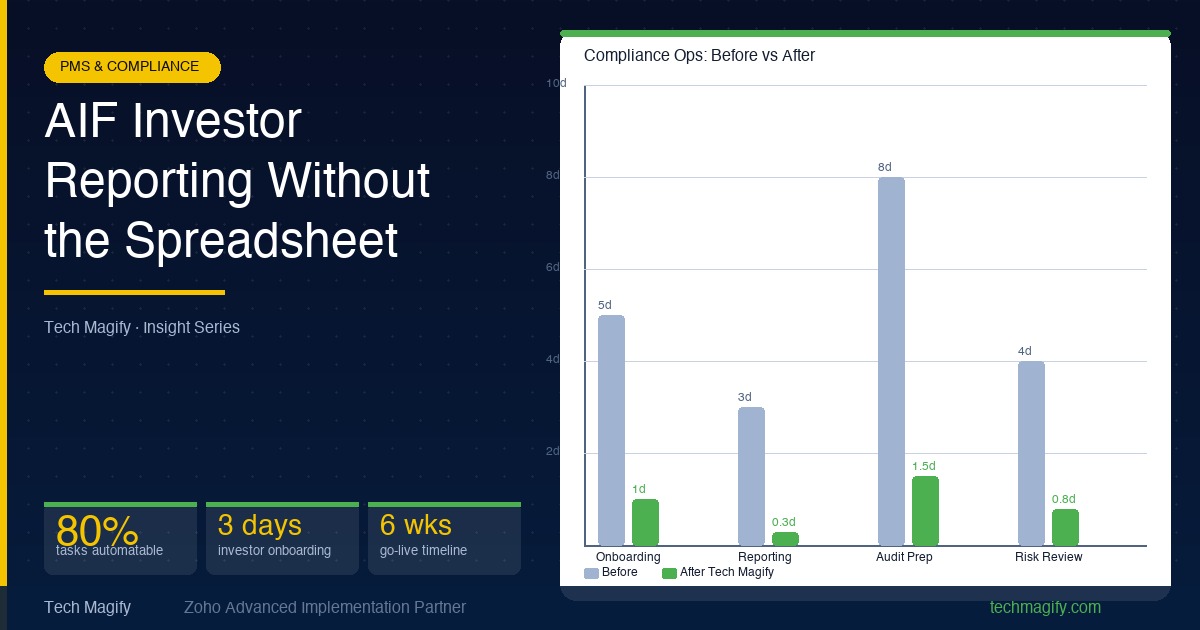
Moving from spreadsheet-based reporting to an automated system sounds daunting, but the implementation timeline is typically measured in weeks, not months. Tech Magify follows a phased approach: investor master and scheme setup in week one, historical data migration and validation in weeks two and three, UAT with your ops team in week four, and parallel run alongside your existing process in weeks five and six. By the end of the parallel run, every team member has seen the automated output match or exceed the accuracy of their manual process, and the switch becomes a matter of confidence rather than faith.
\n
The firms that hesitate longest are usually the ones whose spreadsheets have become so complex that no single person understands all of them. That complexity is not a reason to delay. It is the strongest possible argument for moving to a system where the logic is documented, testable, and not dependent on any one person’s institutional memory.
\n\n
\”We used to spend the first two weeks of every quarter on investor reports. Now it takes two days, and the accuracy is better than anything we produced manually.\” — Operations head at a Category II AIF, post Tech Magify implementation
“,”cta_headline”:”Replace Spreadsheet Chaos With Reports Your Investors Actually Trust”,”cta_body”:”Book a 30-minute consultation with Tech Magify to see how your AIF’s investor reporting, capital account statements, and SEBI compliance filings can run from a single automated system. We will walk you through exactly what the transition looks like for a fund of your size and complexity.”}
Ready to Deliver Investor Reports That Build Confidence, Not Confusion?
Tech Magify builds automated AIF reporting workflows on Zoho that eliminate manual data wrangling and get accurate statements to your investors on schedule. Book a 30-minute consultation to see exactly how your reporting process transforms.