Most businesses that start with Zoho begin with one product. It is usually Zoho CRM — because the sales team needs a better way to manage leads — or Zoho Books, because the accounting team wants GST-compliant invoicing with less manual work. The initial deployment goes well, the team adapts, and the business starts to see results. Then someone asks a reasonable question: if we are already on Zoho, why are we still using a separate tool for HR? For project management? For customer support?
This is the moment when organisations begin to understand what Zoho actually is. Not a CRM company, not an accounting software vendor, but a comprehensive business operating platform — 55-plus applications covering every core business function, all sharing a single data infrastructure, all designed to work together without the integration headaches that come from connecting tools built by different companies on different architectures.
The Architecture That Makes the Ecosystem Work
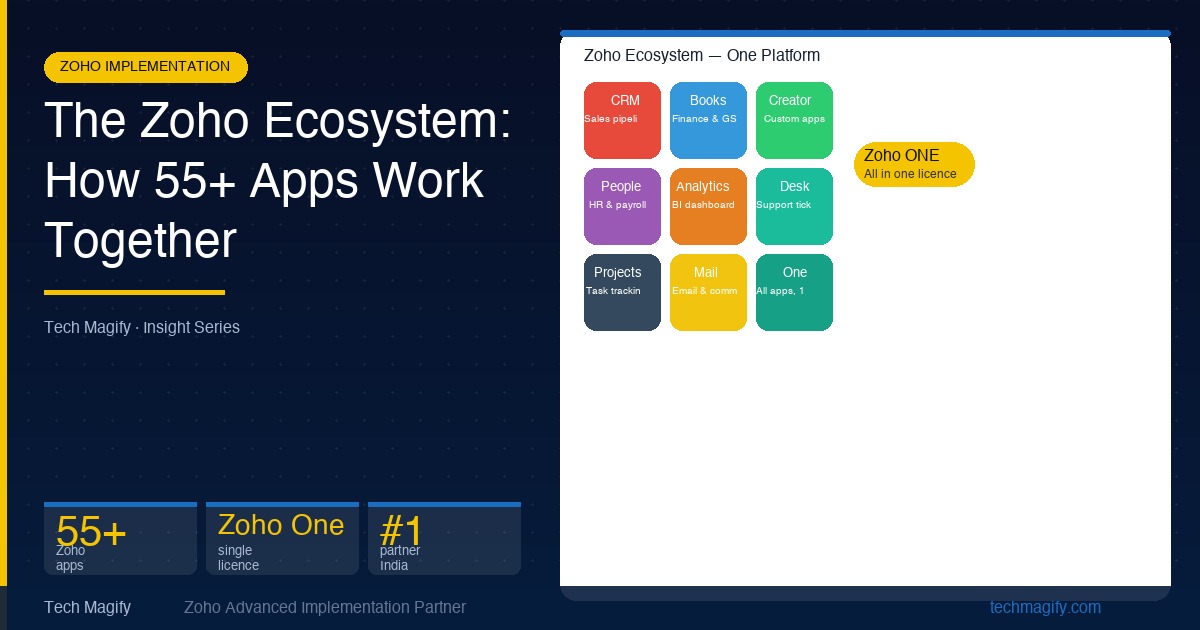
Understanding why Zoho’s ecosystem delivers more value than the sum of its parts requires understanding how the data flows. Every Zoho application — CRM, Books, People, Desk, Projects, Analytics, Campaigns, Creator, and the rest — is built on Zoho’s unified data platform. This means a customer record created in Zoho CRM is the same record that appears in Zoho Books when an invoice is raised, in Zoho Desk when a support ticket is filed, and in Zoho Analytics when the finance team runs a revenue report.
There is no synchronisation delay, no mapping exercise, no integration to build and maintain. The data is shared natively. When a deal closes in CRM, the customer is automatically created in Books. When an employee is hired in Zoho Recruit, their record flows to Zoho People and payroll. When an inventory item falls below reorder level in Zoho Inventory, a purchase order can be triggered automatically through Zoho Flow. These connections are not custom integrations — they are built-in platform behaviours that any implementation can activate.
The Five Functional Pillars of the Zoho Suite
Sales and CRM. Zoho CRM is the most widely deployed Zoho product, and for good reason. It manages the full sales lifecycle from lead capture through to deal close and post-sale relationship management. Zoho SalesIQ adds live chat and visitor tracking. Zoho Campaigns manages email marketing. Zoho Social handles social media scheduling and engagement. Together, these tools cover the entire customer acquisition and retention cycle.
Finance and Operations. Zoho Books handles accounting, invoicing, expenses, and GST compliance for Indian businesses. Zoho Inventory manages stock, purchase orders, and fulfilment. Zoho Expense automates expense reporting and reimbursement. Zoho Subscription handles recurring billing for SaaS and service businesses. For finance teams, this stack replaces multiple disconnected tools and eliminates the manual reconciliation between sales data, inventory records, and accounting entries.
People and HR. Zoho People covers the full employee lifecycle: onboarding, attendance, leave management, performance reviews, and exit processes. Zoho Recruit manages job requisitions, candidate pipelines, and offer management. Zoho Payroll — available for Indian payroll with statutory compliance — completes the HR stack. Organisations running all three see significant reductions in HR administrative overhead and improved employee experience from consistent, self-service workflows.
Customer Service and Support. Zoho Desk is a full-featured helpdesk platform with ticket management, SLA tracking, knowledge base management, and AI-powered response suggestions. For businesses with customer support operations, Zoho Desk integrated with CRM provides support agents with complete customer context on every ticket — purchase history, previous interactions, active contracts — without switching between systems.
Business Intelligence and Custom Development. Zoho Analytics provides unified reporting across every data source in the ecosystem — and beyond, connecting to external databases and third-party platforms. Zoho Creator is a low-code development platform that allows businesses to build custom applications on top of the Zoho data infrastructure without conventional software development. For organisations with unique operational requirements that standard modules do not cover, Creator is how those requirements get addressed without a separate software project.
Zoho One: The All-In-One Subscription
Zoho One is the subscription that unlocks the full suite — all 55-plus applications — for a per-user monthly fee that competes directly with the cost of subscribing to even two or three best-of-breed SaaS tools separately. For businesses that are currently paying for Salesforce, QuickBooks, BambooHR, Zendesk, and Mailchimp — each with its own integration overhead — moving to Zoho One typically reduces software costs while increasing the depth of integration between functions.
The financial case for Zoho One is clearest for businesses in the 20-to-500 employee range. Below this, the full suite may be more than the business needs. Above it, enterprise requirements may warrant platform evaluation against enterprise-tier alternatives. In the middle, Zoho One is frequently the most cost-effective way to run an integrated business operation.
The Role of the Implementation Partner
The Zoho ecosystem’s breadth is also its implementation challenge. A business that deploys Zoho One and tries to configure 15 applications simultaneously will struggle. The right approach is a phased deployment: core modules first, with later phases adding capabilities as the team adapts and the business articulates new requirements clearly.
This is where a Zoho Advanced Implementation Partner adds disproportionate value. The partner’s job is not just to configure individual applications correctly — it is to design the data architecture and integration flows so that the ecosystem functions as one connected system rather than a collection of separately configured tools. A poorly designed Zoho implementation can produce the same data silos and manual workarounds that plague businesses using disconnected best-of-breed tools. A well-designed one eliminates them.
TCG and Emkay Global are among the organisations that have implemented substantial Zoho ecosystems with Tech Magify’s support — moving from fragmented operations to unified platforms where sales, finance, and operations data flow through a single connected system.
Starting the Right Way
The best Zoho implementations begin with a clear process and data audit: what are the core business workflows, where does data originate, how does it need to flow across functions, and what are the specific outcomes the business is trying to achieve? Technology decisions follow from this analysis — not the other way around.
If your business is evaluating Zoho, consolidating existing tools onto the platform, or looking to extend a current Zoho deployment into new functional areas, a structured discovery conversation is where the work starts. Book a free call with the Tech Magify team at bookings.techmagify.com. As a Zoho Advanced Implementation Partner with deep experience across the full suite, we can give you an honest view of what a well-designed Zoho ecosystem looks like for your specific business — and what it takes to get there.
Want to understand what Zoho can do for your business?
As a Zoho Advanced Partner, we’ve helped businesses across financial services implement Zoho at scale. Book a free discovery call.