Most Portfolio Management Service firms in India reach a familiar inflection point about three to four years into their growth journey. Client counts cross 100, AUM edges past ₹500 crore, and the back office — built on spreadsheets, email threads, and manually assembled reports — begins to show its cracks. Reconciliation takes two days instead of two hours. Investor statements run late. A fresh regulatory requirement from SEBI lands, and nobody is certain which spreadsheet needs updating first.
This is not a niche problem. It describes the operational reality for a significant proportion of India’s 400-plus registered PMS providers. The solution is not complicated in principle, but execution determines whether a firm scales confidently or stumbles under its own complexity.
What “Digitisation” Actually Means for a PMS Back-Office
The word gets used loosely. For a PMS firm, digitisation is not about having a client portal or moving files to cloud storage. It means replacing manual, person-dependent processes with automated, system-driven workflows — specifically in the areas that directly affect regulatory compliance, investor experience, and operational efficiency.
The core processes that benefit most are: investor onboarding and KYC verification, portfolio data reconciliation, NAV computation and statement generation, distributor management, investor communication, and the reporting obligations mandated under SEBI’s PMS Regulations, 2020. Each of these touches both the investor-facing experience and the compliance record. Getting either wrong carries real consequences — client attrition on one side, SEBI scrutiny on the other.
Why SEBI Compliance Exposes the Limits of Spreadsheets
SEBI’s PMS Regulations impose clear obligations on registered portfolio managers: quarterly reporting to clients, transparent disclosure of fees and expenses, maintenance of prescribed records, and structured investor communication formats. These requirements are not unreasonable in isolation. The problem is volume and consistency at scale.
A firm managing 200 clients across three investment strategies must produce accurate, consistent reports for each client, each quarter, in formats that satisfy both investors and regulators. Doing this manually across a spreadsheet infrastructure is not just slow — it is error-prone in ways that auditors and SEBI inspectors will identify. A mismatched NAV figure or an inconsistently applied fee calculation is not merely an operational inconvenience. It is a compliance risk with regulatory consequences.
Firms that have solved this problem share a common approach: they built a single source of truth for portfolio data and automated the reporting layer on top of it. Platforms like Zoho Creator, combined with CRM and document automation modules, make this achievable without a large in-house technology team.
What a Digitised PMS Operation Looks Like in Practice
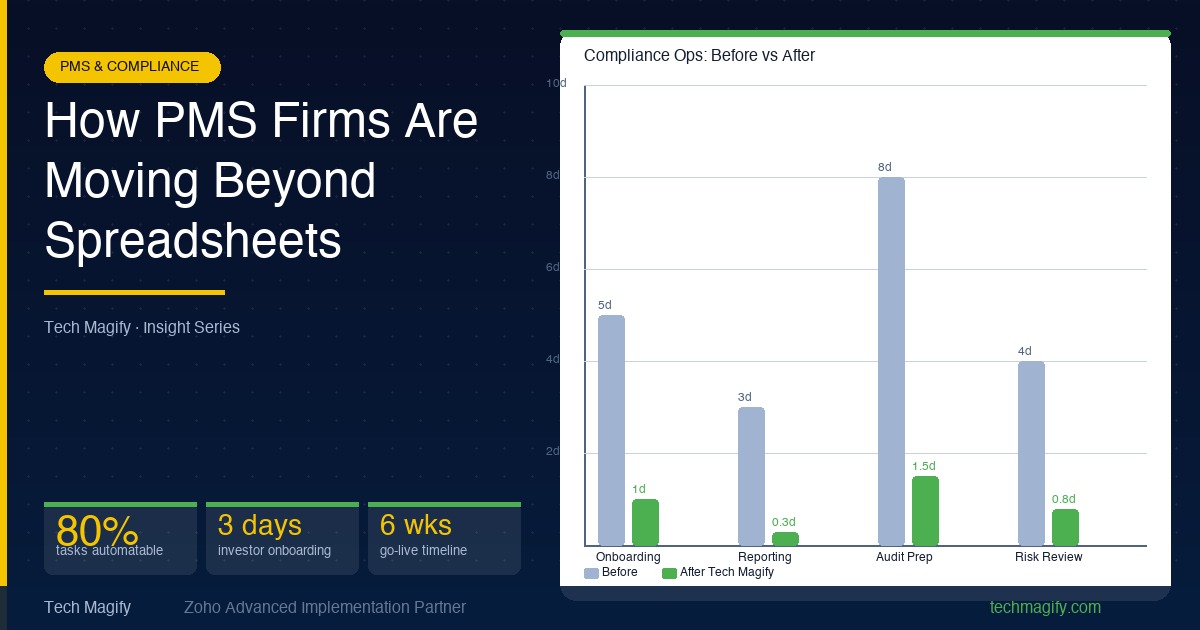
Consider how investor onboarding changes when the right technology is in place. In a manual environment, onboarding a new client means collecting KYC documents via email, entering data into multiple spreadsheets, cross-referencing with the depository, drafting a welcome letter, and updating the fee schedule in a separate file. The process typically takes three to five working days and involves at least three team members.
In a digitised environment, the investor completes a structured onboarding form. The data flows directly into the CRM, triggering a KYC verification workflow, a document checklist, and an automated welcome communication. The portfolio management system receives the client record without any manual handoff. Onboarding takes one day, involves a single touchpoint, and generates a full audit trail at every stage.
PMS firms like Abakkus and ValueQuest have implemented exactly this kind of structured digital back-office — moving from spreadsheet-heavy processes to Zoho-based workflows that handle investor onboarding, portfolio updates, and monthly statement generation with minimal manual intervention.
CRM as the Nerve Centre for Distributor and Investor Relationships
Most PMS firms do not operate in a direct-only model. They manage a distributor network — independent financial advisors, RIAs, and bank wealth management arms — who refer and service clients on their behalf. Managing these relationships through email and phone creates information gaps that affect both revenue and compliance oversight.
A CRM configured for PMS operations tracks each distributor’s client portfolio, commission structure, and communication history in one place. When an investor raises a query, the relationship manager has full context immediately. When SEBI requests a record of client interactions, the system produces it on demand. This level of visibility is not achievable with spreadsheets. It requires a CRM built around the PMS workflow, with modules for investors, distributors, portfolios, and compliance tasks working together as one connected system.
Scaling Without Proportional Headcount Growth
The economics of a PMS business depend on operating leverage. Revenue grows with AUM; costs should not grow at the same pace. For firms in the ₹500 crore to ₹2,000 crore range, the operations team is often already stretched. The default response — hire more staff — solves the immediate problem but compresses margins over time.
Technology addresses this differently. When investor reporting is automated, adding 50 new clients does not add 50 hours of work. When onboarding is digital, one operations executive manages what previously required three. When portfolio reconciliation runs automatically overnight, the team reviews exceptions rather than rebuilding the data set from scratch each morning.
This is the operating model that allows a PMS firm to grow from ₹500 crore to ₹3,000 crore without doubling operations headcount. It is not a distant aspiration; it is the documented outcome for firms that have invested in the right technology infrastructure at the right time.
Choosing the Right Approach
The most common mistake PMS firms make when digitising is building in isolation. An investor portal here, a reporting tool there, a CRM that does not connect to the portfolio system. The result is a different kind of complexity — multiple systems with no single source of truth, and integration headaches that consume the team’s energy rather than freeing it.
The right approach begins with a clear process map: what data originates where, what workflows depend on that data, and where the compliance obligations sit in the chain. Technology decisions follow from there. For most PMS firms, a Zoho-based implementation covering CRM, workflow automation, document generation, and client communication offers the best balance of capability, integration depth, and total cost of ownership.
Implementation quality matters as much as platform selection. A Zoho Advanced Partner with specific experience in PMS operations will configure the system around your regulatory obligations and investor workflows — not a generic CRM template adapted from a retail or manufacturing context.
If your firm is evaluating its technology infrastructure, or if your operations team is still spending significant time on processes that should be automated, a focused discovery conversation is the right starting point. Book a free discovery call with the Tech Magify team at bookings.techmagify.com. We have worked with PMS firms at every stage of their digitisation journey and can give you a clear, honest view of what the right solution looks like for your specific operation.
Ready to move your PMS off spreadsheets?
We work exclusively with SEBI-regulated firms. Book a free discovery call and we’ll map out exactly what your back-office modernisation should look like.