
The Real Cost of Running a PMS Back-Office on Spreadsheets
It starts innocently enough. A single Excel file tracking client portfolios. Another one for fee calculations. A third for compliance reporting. Before you know it, your entire Portfolio Management Services back-office is running on a tangled web of spreadsheets, held together by formulas that only one person truly understands. And when that person goes on leave or, worse, resigns — you are staring at a crisis nobody planned for.
If you run a PMS firm in India, chances are high that some version of this story sounds familiar. The spreadsheet problem is not just about technology. It is about risk, reputation, regulatory exposure, and the silent bleeding of money that most firms do not even recognize until it is too late.
The Hidden Financial Drain Nobody Talks About
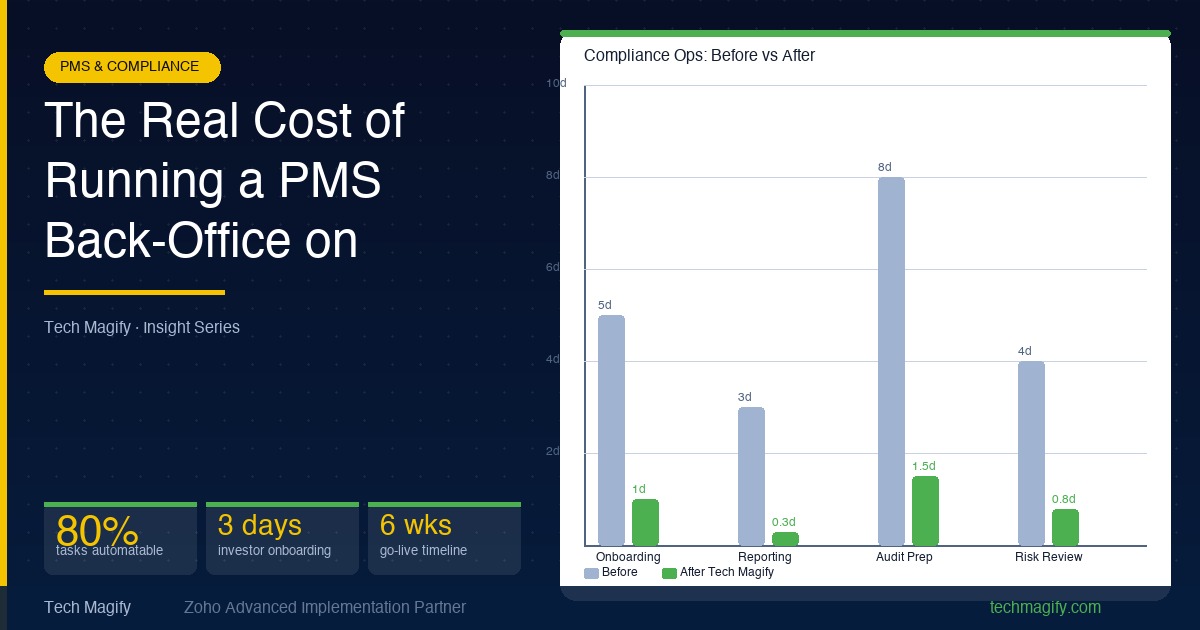
Let us get specific. A mid-sized PMS firm managing 200 to 500 client accounts typically has at least three to five people whose primary job involves entering, reconciling, and cross-checking data across spreadsheets. Salary costs aside, consider the hours lost to manual reconciliation — matching trade data from brokers, verifying NAV calculations, preparing quarterly performance reports, and generating fee invoices. Industry estimates suggest that firms relying heavily on manual processes spend 30 to 40 percent more on operational overhead compared to those using dedicated systems.
But the direct labor cost is only the tip of the iceberg. The real damage comes from errors. A misplaced decimal in a fee calculation. A copy-paste mistake that inflates a client’s reported return. A broken formula that silently corrupts an entire quarter’s compliance data. Each of these incidents carries a cost — sometimes financial, sometimes reputational, and sometimes regulatory. SEBI does not accept “spreadsheet error” as an excuse during an inspection.
Compliance Is Where Spreadsheets Truly Fail
PMS firms operate under stringent SEBI regulations. From investment restrictions and concentration limits to disclosure norms and performance reporting standards, the compliance burden is substantial and growing. Spreadsheets have no built-in audit trails. They do not flag breaches in real time. They cannot automatically generate the reports SEBI expects in the format SEBI expects them. Every compliance check becomes a manual exercise, and manual exercises invite human error.
Consider what happens during a SEBI inspection. Inspectors want to see a clear trail of every investment decision, every client communication, every fee charged. They want time-stamped records. They want consistency across reports. A spreadsheet-based back-office typically scrambles for days — sometimes weeks — to compile this information. Firms that have invested in proper portfolio management software development, on the other hand, can pull this data in minutes.
“The firms that get into trouble with SEBI are rarely the ones making bad investment calls. They are the ones that cannot prove they followed the right process.” — A compliance officer at a leading PMS firm
The Client Experience Gap
Today’s PMS clients are not the same as they were a decade ago. They are digitally savvy, accustomed to real-time dashboards from their mutual fund apps, and increasingly demanding transparency. When a PMS firm sends a quarterly PDF report generated from a spreadsheet — often delayed by a week or more because the operations team is still reconciling data — it creates a perception problem. Clients begin to wonder whether the firm is truly equipped to manage their wealth professionally.
Leading wealth management software providers have already addressed this gap by offering client-facing portals with real-time portfolio views, transaction histories, and performance analytics. Firms that continue to rely on spreadsheets simply cannot offer this level of transparency. And in a market where client acquisition costs are rising, losing a high-net-worth client over poor reporting is an expensive mistake.
Why Firms Stay Stuck on Spreadsheets
If spreadsheets are so problematic, why do firms persist? The reasons are predictable. First, there is the upfront cost concern. Building or buying a proper system feels expensive compared to the “free” spreadsheet. Second, there is the disruption fear. Migration feels risky when your entire operation depends on existing files. Third, and perhaps most importantly, there is the familiarity trap. People know Excel. They are comfortable with it. Change is hard.
But here is the uncomfortable truth: the cost of staying on spreadsheets compounds every single month. As your client base grows, the complexity does not scale linearly — it scales exponentially. What worked for 50 clients becomes a nightmare at 300. Firms that delay the transition inevitably end up paying more when they finally make the move, because they are now dealing with years of unstructured data that needs to be cleaned and migrated.
Building the Right Technology Foundation
The good news is that the solution landscape has matured significantly. Wealth management platform providers now offer systems specifically designed for Indian PMS operations, with built-in compliance modules, automated fee calculations, broker integration, and client reporting. For firms looking at custom solutions, wealth management software development has become more accessible and cost-effective, with specialized teams that understand both the technology and the regulatory nuances.
Some firms also explore platforms like Zoho for managing CRM, client communication, and operational workflows alongside their core PMS software. Working with a zoho certified consultant can help firms design workflows that eliminate redundant data entry and create seamless connections between front-office and back-office functions. Whether you are looking for zoho implementation partners in your region or seeking a zoho premium partner for enterprise-grade deployments, the ecosystem has expanded considerably.
Firms based in major financial hubs have the advantage of proximity to specialized technology partners. A zoho partner bangalore can assist firms in the southern region with on-ground support, while a zoho partner mumbai can serve firms operating out of India’s financial capital. The key is finding an authorized zoho partner or zoho authorised partner who understands the specific compliance and operational demands of the PMS industry, rather than a generalist who treats every business the same way. Zoho authorized partners with financial services experience can make a meaningful difference in implementation quality and timeline.
The Real Question Is Not Cost — It Is Timing
Every PMS firm will eventually move off spreadsheets. The regulatory environment demands it. Client expectations demand it. Operational sanity demands it. The only question is whether you make that transition proactively — on your terms, with time to plan and implement properly — or reactively, after a compliance incident, a client complaint, or a costly operational failure forces your hand.
The firms that are winning in today’s PMS landscape are not necessarily the ones with the best stock picks. They are the ones with the most efficient operations, the cleanest compliance records, and the most transparent client communication. None of that is achievable at scale with spreadsheets.
“We calculated that our spreadsheet-based operations were costing us roughly 18 lakhs per year in hidden inefficiencies — and that was before we factored in the risk of a compliance penalty.” — Operations head at a Bengaluru-based PMS firm
If your back-office still runs on Excel, the cost is not zero. It is just invisible. And invisible costs are the most dangerous kind because they grow silently until the day they become impossible to ignore. That day, for most PMS firms still clinging to spreadsheets, is closer than they think.
Ready to Retire the Spreadsheets That Are Quietly Bleeding Your Firm?
Tech Magify has helped firms like Abakkus, ValueQuest, and Emkay Global move from fragile spreadsheets to fully automated PMS operations on Zoho. Book a 30-minute consultation and we will map your current back-office costs against what a purpose-built system actually delivers.